
Which smart metering protocol works best with multiple vendors? For many electricity-metering projects, DLMS/COSEM is the strongest starting point for standardized meter data exchange. Its object model, established security mechanisms, and conformance-testing ecosystem make it a practical foundation for multivendor advanced metering infrastructure (AMI).
But a protocol name alone does not guarantee interchangeable equipment. Two meters can support DLMS/COSEM yet expose different objects, implement different optional features, or require different security provisioning. Regional requirements, communication networks, and existing head-end systems can also make another approach more appropriate.
The useful question is therefore not simply “Which standard is best?” It is: Which protocol, implementation profile, and acceptance process will let your utility add or replace vendors without rebuilding the integration? That distinction matters long after the initial rollout, when firmware changes, network migrations, and replacement meters begin testing the architecture.
Separate meter data exchange from the network carrying it
Protocol comparisons often become confusing because they mix technologies that solve different problems. DLMS/COSEM, cellular connectivity, and MQTT are not direct substitutes.
Before evaluating suppliers, divide the architecture into three responsibilities:
- Meter data and application services: How readings, load profiles, events, tariffs, and control functions are represented and accessed.
- Communication transport: How messages travel through cellular networks, radio mesh, power-line communication, Ethernet, or local serial connections.
- Enterprise integration: How validated information reaches meter data management, billing, outage management, and analytics applications.
A deployment might use DLMS/COSEM for meter interactions, a cellular network for connectivity, and an API or messaging platform for upstream distribution. Each layer needs compatibility rules, but choosing one does not automatically settle the others.
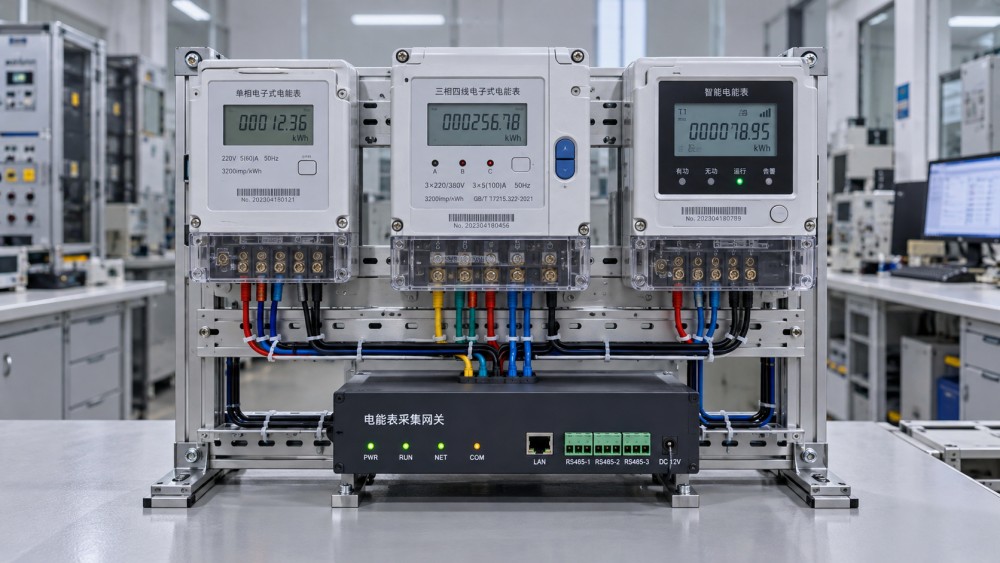
This separation also prevents a common procurement mistake: accepting “IP-compatible” as evidence of meter interoperability. IP connectivity establishes a communication path. It does not ensure that two devices interpret a register, timestamp, or disconnect command in the same way.
Where the main protocol options fit
IEC 61850 may also appear in grid integration discussions. It is important for power-system automation, particularly substations, but is not generally the default protocol for mass-market billing-meter fleets. Its relevance depends on whether the project concerns revenue metering, industrial monitoring, or automation at grid assets.
Why DLMS/COSEM usually leads the shortlist
DLMS/COSEM combines communication services with an object-oriented meter model. COSEM interface classes describe functions and data; OBIS codes identify quantities and related information. That shared vocabulary reduces the need to invent a proprietary meaning for every measurement.
For a utility buying meters from several manufacturers, this provides a stronger foundation than a collection of unrelated register maps. A head-end system can work against an agreed set of objects and services rather than treating every meter as an entirely separate integration.
The qualification is important: standardized does not mean identically implemented. Supported interface-class versions, association settings, access permissions, load-profile layouts, and communication options can vary. Manufacturer-specific objects may still be necessary, but critical functions should not depend on undocumented extensions.
When another option is the better fit
An established North American utility may find the ANSI C12 ecosystem more practical because its systems, procedures, and approved meters already align with it. Replacing that foundation solely to adopt a different international standard can introduce more risk than value.
For a factory collecting energy readings from switchboards, Modbus may be sufficient. Its simplicity is useful when the device population is controlled and an integration team maintains the register mappings. It becomes less attractive when the objective is interchangeable meters across a large, evolving fleet.
Water, gas, and heat projects deserve their own assessment. M-Bus or wireless M-Bus may better match available devices, battery constraints, and reading requirements. A gateway can unify upstream data, but it does not make the underlying meters interchangeable.
Turn protocol support into a testable purchasing requirement
The most consequential work happens between selecting a standard and issuing the purchase order. A tender that says only “must support DLMS/COSEM” leaves too many decisions to individual suppliers.
1. Define the functions that must survive a vendor change
Start with operational outcomes: billing reads, interval profiles, outage events, clock synchronization, tariff updates, and any authorized remote-control functions. Separate mandatory capabilities from optional enhancements.
For each function, specify the data identity, unit, scaling, timestamp convention, access rights, and expected behavior. Import and export energy must remain distinguishable. Missing intervals must not silently become zero consumption. Daylight-saving transitions must not create unexplained duplicates.
This is where multivendor compatibility becomes concrete. A billing system does not care that both meters claim compliance if one delivers differently scaled values without reliable metadata.
2. Freeze a shared implementation profile
Document the applicable standard editions, required objects or tables, supported services, security configuration, and communication bindings. Reference national or utility profiles where appropriate, then resolve any remaining choices explicitly.
Ask suppliers to provide machine-readable object lists or equivalent structured documentation where available. Record deviations in a compatibility matrix rather than leaving them scattered through clarification emails.
The goal is not to prohibit every extension. It is to ensure that essential operations use the common profile and that extensions remain visible, documented, and avoidable when changing suppliers.
3. Check certification scope, not just the certificate
Conformance evidence is valuable because it tests implementation against defined requirements. However, conformance testing is not the same as end-to-end interoperability testing.
Verify what was tested, which product and firmware version the evidence covers, and whether the tested scope matches your required features. Then run the actual meters against the intended head-end system. A laboratory result cannot establish that your entire operational workflow works across every vendor combination.
Run a “replace one vendor” pilot before scaling
A convincing demonstration often involves one supplier’s meter, gateway, and software working together. That proves the supplier’s stack works. It does not prove that your architecture is open.
A stronger pilot keeps the utility’s requirements constant while changing components. Connect meters from different suppliers to the intended head-end environment, then verify that normal operations do not require undocumented customization.
- Routine collection: Read billing registers and interval profiles, including units, scalers, status flags, and timestamps.
- Interrupted communications: Disconnect links, restore service, and check recovery, duplicate handling, and historical retrieval.
- Time management: Test clock correction, time zones, and daylight-saving behavior where applicable.
- Security operations: Exercise credential provisioning, key rotation, access restrictions, and recovery procedures.
- Lifecycle changes: Upgrade firmware, replace a meter, and verify that integrations remain valid.
- Control functions: Where permitted, test command authorization, confirmation, and device-state reporting under controlled conditions.
Include realistic network conditions. Weak coverage, constrained bandwidth, and simultaneous reconnection after an outage can reveal problems that a bench test misses. Measure collection completion, recovery behavior, and operational effort against thresholds defined before testing.
For remote disconnect or reconnect, protocol compatibility is only one requirement. Safety interlocks, authorization policies, local regulations, and auditable procedures must also govern execution.
Make security portable across suppliers
A multivendor deployment can still create lock-in if one manufacturer controls every credential and provisioning tool. Security architecture deserves the same attention as data compatibility.
Require a documented approach to unique device credentials, secure onboarding, key ownership, rotation, revocation, and replacement. Clarify whether the utility can operate its chosen key-management infrastructure and how authorized service providers receive limited access.
Do not treat a protocol’s security features as automatically enabled protection. The selected security suite, configuration, implementation quality, and operational processes determine the actual result. Likewise, basic Modbus should not be assumed to provide authentication or encryption; industrial deployments need an appropriate protective architecture.
Remote firmware management also needs explicit requirements. Ask how updates are authenticated, how failures are handled, and what happens when a manufacturer stops supporting a product. A common metering protocol does not, by itself, guarantee a common firmware-update process.
Compare lifecycle integration costs—not just meter prices
The cheapest device can become the expensive choice if every firmware release requires a new driver. Conversely, replacing a stable legacy estate may cost more than maintaining a well-defined gateway layer.
Evaluate costs across the expected service life:
- Initial head-end integration and data mapping.
- Conformance review, interoperability testing, and regression testing.
- Security provisioning and ongoing credential management.
- Network charges, troubleshooting, and field interventions.
- Software licensing, adapter maintenance, and support arrangements.
- Vendor replacement, data export, and platform migration.
Gateways can sensibly normalize legacy protocols, particularly during phased modernization. Their translation rules nevertheless need ownership, version control, and testing. Converting a message format does not automatically preserve meaning, event priority, or command behavior.
For power-sector decision-makers, the durable value of an open standard is not the logo on a datasheet. It is the ability to introduce another supplier without reopening every operational dependency.
A practical decision rule
For a new multivendor electricity AMI deployment, shortlist DLMS/COSEM first, then validate local requirements, available certified implementations, network suitability, and head-end support. For an established ANSI C12 environment, assess the cost and risk of changing ecosystems before pursuing a different standard. For industrial submetering or mixed-utility collection, choose according to the actual devices and operating requirements rather than forcing one protocol everywhere.
The best answer to “Which smart metering protocol works best with multiple vendors?” is therefore a standard supported by a precise common profile, independent evidence, and realistic replacement testing. Specify the behaviors you need, prove them across suppliers, and retain control of data and security. That is what turns protocol compatibility into lasting procurement freedom.
Related News
- Which Smart Metering Protocol Is Best for Multivendor Systems?Nov 03, 2026Which smart metering protocol works best with multiple vendors? Compare DLMS/COSEM and alternatives, reduce vendor lock-in, and discover how to validate interoperability before you buy.
- Prioritizing high voltage network maintenance by asset conditionNov 03, 2026Prioritize high voltage network maintenance by asset condition, failure risk, and operational impact. Discover how to target critical repairs, optimize outages, and make limited budgets count.
- How reactive power tests verify renewable grid compliance at the POIOct 31, 2026Verify renewable POI grid compliance with reactive power tests. Learn how capability checks, control response, and accurate POI measurements build credible evidence and reduce approval risks.
- How energy imbalance markets are changing transmission schedulingOct 28, 2026Explore energy imbalance markets and the future of transmission schedules. Discover how real-time dispatch, congestion, and delivery risks shape smarter procurement and investment decisions.
Related News
- 00
0000-00
How to assess a smart grid device manufacturer's interoperability - 00
0000-00
How to size a containerized energy storage system for peak shaving - 00
0000-00
How to use a global power matrix for procurement negotiations - 00
0000-00
Can an electrical grid platform integrate with legacy SCADA systems? - 00
0000-00
Can an electrical grid intelligence dashboard detect outages?