
Green energy tenders can require carbon footprint data, but the label “green” does not create a universal disclosure obligation. The requirement depends on the applicable procurement rules, the buyer’s conditions, and the specific contract. A renewable energy project may request product-level emissions, a corporate carbon reduction plan, both, or neither.
The decisive distinction is whether carbon data is an eligibility condition, a scored award criterion, or a contractual deliverable. Missing mandatory evidence can make a bid non-compliant; weak evidence under a scoring criterion can reduce its competitiveness. Before commissioning an assessment, establish exactly what is requested, when it must be submitted, and how it will affect the award.
Determine what the tender actually requires
Do not rely on the tender notice or sustainability summary alone. Carbon obligations may appear in the technical specification, supplier questionnaire, evaluation methodology, pricing workbook, environmental annex, or draft contract. Published clarifications and amendments can change the original requirements.
Search the complete document set for terms such as “carbon footprint,” “embodied carbon,” “greenhouse gas,” “lifecycle assessment,” “environmental product declaration,” “Scope 3,” and “carbon reduction plan.” Then read the surrounding clauses: similar terminology can describe very different obligations.
A tender can combine these conditions. It might require a corporate emissions plan for qualification, score the equipment’s embodied carbon, and require updated transport emissions after delivery. One document will not necessarily satisfy all three.
Match the evidence to the level being assessed
The most consequential mistake is submitting valid environmental information that answers the wrong question. An organization’s emissions inventory, a product carbon footprint, and a project lifecycle assessment describe different systems.
Corporate emissions disclosures
A corporate inventory reports emissions within a defined organizational boundary and reporting period. It may include Scope 1 direct emissions, Scope 2 emissions from purchased energy, and specified Scope 3 value-chain emissions. The GHG Protocol Corporate Standard and ISO 14064-1 are relevant frameworks for organizational reporting.
This evidence can support requirements concerning supplier governance or emissions management. It does not establish the footprint of a particular transformer, inverter, cable, or motor. Allocating a company’s annual emissions across sales without an appropriate product methodology is not a substitute for a product assessment.
Product carbon footprints and environmental declarations
A product carbon footprint quantifies greenhouse gas emissions for a defined product and system boundary. ISO 14067 provides requirements and guidance for product carbon footprint quantification, drawing on lifecycle assessment principles in ISO 14040 and ISO 14044.
An environmental product declaration, or EPD, reports environmental information under a defined program and product category rules. ISO 14025 provides the framework for Type III environmental declarations. An EPD can include climate-change indicators alongside other environmental impacts; it is not simply another name for a carbon footprint report.
If an EPD is requested, check the accepted program, applicable product category rules, validity requirements, and verification arrangements. A standalone carbon calculation may not meet that requirement, even if its emissions estimate is technically sound.
Project-level lifecycle emissions
A project assessment can cover equipment production, construction, transport, installation, operation, maintenance, replacement, and end-of-life treatment. Equipment suppliers contribute inputs, but their product reports do not necessarily represent the entire project.
A renewable electricity certificate is different again: it evidences specified electricity attributes under its scheme. It does not, by itself, quantify the embodied emissions of the generating equipment or establish a complete lifecycle footprint.
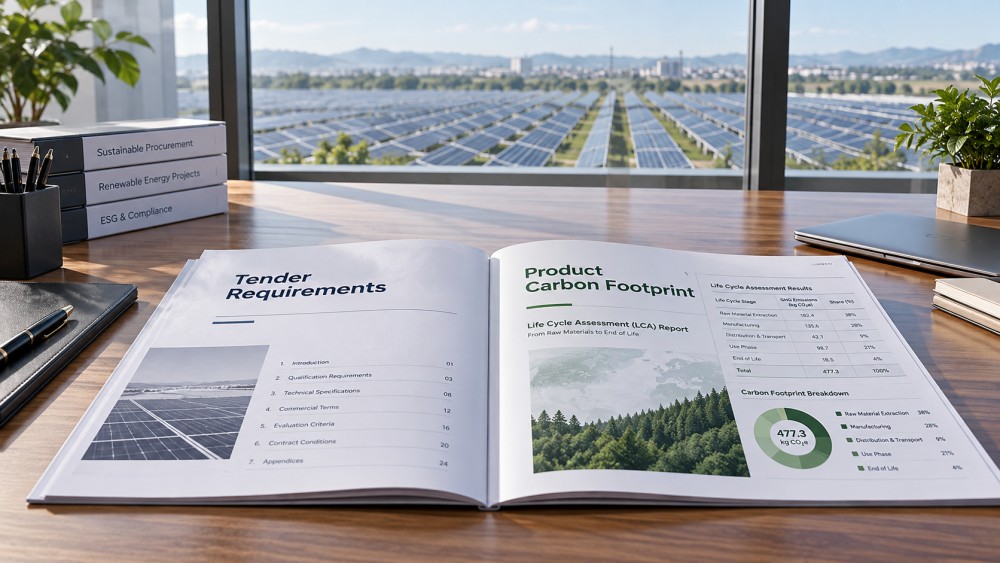
Check the boundary before comparing carbon numbers
A carbon figure is meaningful only when its unit, boundary, and assumptions are clear. A cradle-to-gate assessment ends at the factory gate. A cradle-to-grave assessment extends through later lifecycle stages. Comparing the two as if they represent equivalent coverage can produce a misleading ranking.
The reference unit is equally important. Figures expressed per kilogram of cable, per metre of cable, per transformer, or per kilowatt-hour delivered answer different questions. A lower footprint per kilogram does not necessarily mean lower emissions for an installation that needs more material to achieve the required performance.
For electrical equipment, use-phase assumptions can materially affect the result. Transformer losses, motor efficiency, inverter conversion losses, operating hours, loading, service life, and the assumed electricity mix all influence lifecycle emissions. An equipment option with higher manufacturing emissions could have lower lifecycle emissions under a defined operating profile, but that conclusion needs calculation rather than assertion.
Where the buyer specifies embodied carbon only, provide that result without substituting a broader lifecycle claim. Where lifecycle emissions are evaluated, use the buyer’s operating assumptions. Introducing a more favorable service life or electricity factor makes bids less comparable and may breach the evaluation rules.
Separate legal obligations from buyer-imposed conditions
Carbon information can be required by legislation, procurement policy, financing conditions, or the buyer’s own specification. These sources should not be treated as interchangeable.
EU public procurement rules, for example, provide mechanisms for environmental award criteria and lifecycle costing, subject to applicable conditions. That does not mean every European renewable energy tender requires a product carbon footprint. The particular procurement documents and relevant national rules remain essential.
Likewise, corporate sustainability reporting obligations or emissions-related import requirements do not automatically determine what must accompany a bid. Their reporting boundaries, calculation methods, responsible entities, and deadlines may differ from those in the tender.
A private developer or engineering contractor can impose carbon disclosure requirements through its procurement conditions even where no general law requires that exact report. Such requirements may also flow down to component suppliers. The practical question is not only whether disclosure is required by law, but whether it is a binding condition of the contract being pursued.
Where a clause cites a regulation, policy, or standard, check its scope, applicable version, and any stated implementation provisions. Avoid assuming that a requirement used in another country, project, or earlier tender applies unchanged.
Build an evidence package around the offered equipment
Start with the actual configuration being priced. Carbon results can change with manufacturing location, material composition, rated capacity, design, and component sourcing. A report for a product family is useful only if the tender accepts that coverage and the offered variant falls within it.
A defensible submission should make the connection between the bid and its supporting evidence easy to trace:
- Product identity: model, rating, relevant options, manufacturing site, and the scope of any product-family coverage.
- Assessment basis: reference unit, lifecycle boundary, methodology, applicable product category rules, and exclusions.
- Data basis: reporting period, source of activity data, emission-factor sources, allocation approach, and treatment of estimates.
- Results: emissions in the requested units, with lifecycle-stage breakdowns where required.
- Assurance: verifier or reviewer details, scope of review, statement date, and any qualifications.
Supplier-specific information can strengthen an assessment where it is relevant and methodologically compatible. However, a purchased component’s footprint cannot simply be added to another figure without checking for overlapping boundaries, inconsistent units, or different allocation methods. Double-counting manufacturing energy or transport can distort the total.
Verification must also match the request. “Prepared using ISO 14067” does not mean “independently verified.” An environmental management certificate such as ISO 14001 concerns a management system; it does not certify a product’s carbon footprint.
Renewable electricity claims require similar care. An annual corporate claim does not automatically justify assigning zero emissions to every product made at a facility. The applicable accounting method must determine how electricity attributes are treated and allocated. Carbon offsets should not be deducted from a footprint unless the requested reporting method explicitly permits that presentation; disclose them separately where appropriate.
Resolve missing data before the submission deadline
If a required report is unavailable, establish whether the gap concerns the calculation, product coverage, or verification. These are different problems. An existing assessment may cover the wrong factory, omit a required lifecycle stage, or lack the assurance statement demanded by the buyer.
Use the formal clarification channel to ask whether the buyer accepts an equivalent methodology, representative product data, secondary data for specified inputs, or verification at a later milestone. Ask precise questions tied to the clause. A general request to “accept our sustainability report” gives the buyer little basis for a useful response.
Do not assume missing evidence can be supplied after tender closing. Procurement rules may restrict clarification or supplementation, particularly where new evidence could change the substance of a bid. A promise to calculate the footprint after award is not equivalent to a mandatory report due at submission.
Where estimates are permitted, label them and explain their basis. Identify which inputs use primary records and which use secondary datasets. If the permitted approach applies conservative defaults, account for their effect on the score rather than presenting the estimate as measured performance.
Confidentiality should be addressed at the same stage. Detailed material bills, energy records, or upstream sourcing information may be commercially sensitive. Check whether the buyer will accept an independently verified summary, a restricted technical annex, or controlled access to supporting records. Confidentiality does not remove a disclosure obligation, but an agreed evidence route can protect underlying information.
Use the evaluation rules to decide the level of effort
For a pass-or-fail requirement, the priority is complete, acceptable evidence. A more elaborate lifecycle study adds little if it fails to provide the specific declaration or verification statement requested.
For a scored criterion, examine the weighting, scoring bands, comparison basis, and any cap on points. Better primary data may improve confidence without changing the award score; conversely, an unsupported low figure may receive no credit. The commercial value of additional assessment work depends on these rules, not simply on producing a more detailed report.
For post-award obligations, price the continuing work: updated calculations, subcontractor data collection, independent review, and records supporting any contractual carbon ceiling. Clarify how design changes, material substitutions, and manufacturing-site changes will be handled. A footprint submitted for the original configuration may no longer support the equipment ultimately delivered.
The reliable test is therefore specific: identify the binding clause, establish the assessment level and boundary, confirm the accepted evidence, and meet the stated deadline. Carbon footprint data is required when the applicable rules or tender conditions make it so—not merely because the project produces green energy. The strongest submission is the one whose emissions evidence can be traced directly to the equipment, assumptions, and obligations being evaluated.
Related News
- Do Green Energy Tenders Require Carbon Footprint Data?Oct 28, 2026Do green energy tenders require carbon footprint data? Learn when disclosure is mandatory, what evidence buyers accept, and how to strengthen your bid and avoid compliance pitfalls.
- Sizing Gas Turbine Generators for Continuous Industrial LoadsNov 03, 2026Explore gas turbine solutions sized for continuous industrial loads. Learn how site conditions, redundancy, and lifecycle costs shape reliable power—and make a smarter investment.
- How can the power sector decarbonize without risking grid reliability?Oct 26, 2026Explore the decarbonization process for power sector reliability. Discover how storage, grid upgrades, and smarter planning can cut emissions while keeping power secure.
- What causes study delays in the grid interconnection process?Oct 25, 2026Why does the grid interconnection process face study delays? Explore queue congestion, model issues, and practical ways to reduce rework and protect your project timeline.
Related News
- 00
0000-00
How to assess a smart grid device manufacturer's interoperability - 00
0000-00
How to size a containerized energy storage system for peak shaving - 00
0000-00
How to use a global power matrix for procurement negotiations - 00
0000-00
Can an electrical grid platform integrate with legacy SCADA systems? - 00
0000-00
Can an electrical grid intelligence dashboard detect outages?