
What Drives the Total Cost of Power Distribution Equipment?
For financial approvers, understanding power distribution equipment cost is essential to balancing capital budgets, operational reliability, and long-term energy goals.
The purchase order is only the visible starting point. Total cost depends on technical scope, installation conditions, compliance, lifecycle risk, digital capability, and future system flexibility.
For most projects, the right question is not which supplier offers the lowest equipment price. It is which solution delivers acceptable risk-adjusted cost over its operational life.
A cheaper switchboard can become expensive when it requires civil rework, causes prolonged shutdowns, lacks spare parts, or cannot support later capacity expansion.
Financial approval should therefore distinguish between initial capital expenditure, commissioning expenditure, recurring operating costs, and the potential cost of power disruption or noncompliance.
This distinction matters across industrial plants, data centers, commercial developments, renewable installations, utilities, and transport infrastructure, where failure consequences vary significantly.
The most defensible investment case links each cost premium to a measurable business outcome: reduced downtime, improved safety, lower losses, faster deployment, or protected future capacity.
Start With the Cost Boundary, Not the Equipment Quote
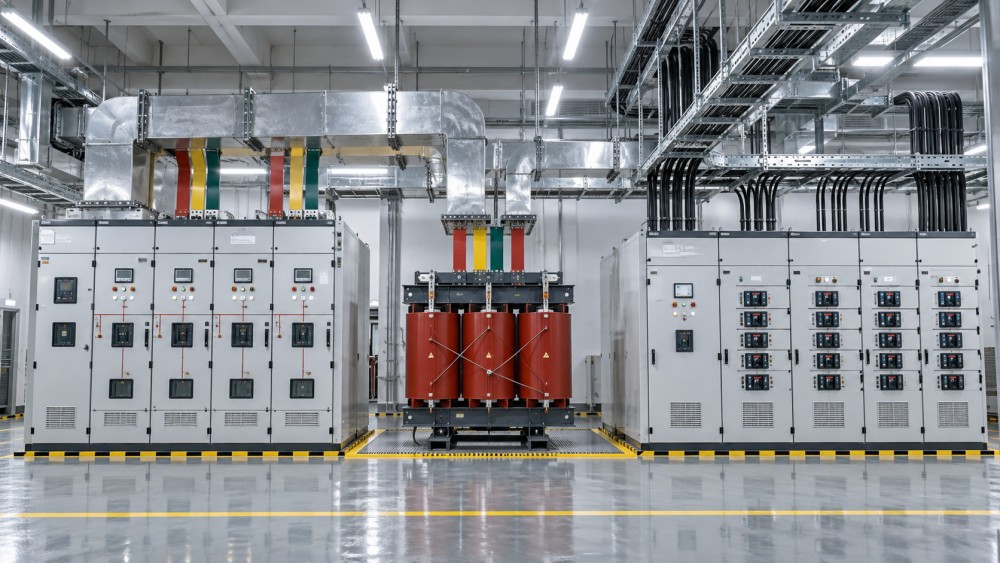
Power distribution equipment cost can refer narrowly to panels and transformers, or broadly to a complete electrical distribution system. Financial reviews should define the boundary before comparisons begin.
A complete scope may include transformers, medium-voltage switchgear, low-voltage switchboards, protection relays, cables, busways, meters, controls, installation, testing, and commissioning services.
It may also include design engineering, utility interface work, fire protection provisions, temporary power, civil modifications, permits, operator training, and post-handover maintenance support.
When vendors price different boundaries, apparent savings are often misleading. One quote may exclude cable routes, remote monitoring, harmonic mitigation, or coordination studies needed for safe operation.
Approvers should request a costed scope matrix showing inclusions, exclusions, assumptions, owner-supplied items, schedule dependencies, and provisional allowances for uncertain conditions.
This matrix converts commercial comparison from a simple price exercise into a decision about delivered capability. It also exposes risks likely to become change orders later.
Where the project is phased, include the cost of interim arrangements. Temporary feeders, duplicate terminations, shutdown windows, and future tie-in work can materially affect total investment.
For major facilities, separate base-build infrastructure from tenant, process, or production loads. This helps prevent core resilience requirements from being diluted by short-term budget pressure.
Technical Ratings and Architecture Drive the Largest Direct Costs
Electrical ratings are usually the strongest direct driver of equipment price. Voltage class, continuous current, short-circuit withstand rating, fault-clearing duty, and insulation requirements all influence design.
Higher voltage equipment requires more robust insulation, clearances, interrupting capability, testing, and specialized manufacturing. These requirements can increase cost faster than capacity alone suggests.
Current ratings affect conductor size, busbar material, heat dissipation, enclosure dimensions, and cooling needs. A modest increase in amperage may require a substantially larger assembly.
Short-circuit ratings deserve particular scrutiny because they cannot be reduced casually. Available fault current depends on utility supply, transformers, generators, motors, and future network changes.
Underspecifying fault duty creates safety and compliance exposure. Overspecifying every component, however, ties up capital in performance that may not be necessary at every distribution level.
System architecture also matters. Radial distribution is often less expensive initially, while double-ended, ring-fed, or selectively coordinated systems improve continuity but add breakers, controls, and commissioning work.
Redundancy should be valued according to the cost of lost load. A hospital, semiconductor plant, financial trading site, or cold-storage operation may justify resilience unavailable in ordinary offices.
Financial teams should ask engineering to quantify critical loads, tolerated outage duration, recovery time, and revenue or safety consequences. That converts reliability design into an investment decision.
Raw Materials and Supply Conditions Can Shift the Budget Quickly
Copper and aluminum prices directly influence transformers, cables, busbars, windings, and conductors. Their impact varies with equipment design, conductor volume, contract timing, and supplier hedging practices.
Copper typically provides compact, high-conductivity designs, while aluminum can reduce material cost but may require larger sections, different terminations, and additional space in some applications.
Neither material is automatically the financially superior choice. The appropriate evaluation includes equipment footprint, installation labor, joint reliability, thermal performance, maintenance practice, and market availability.
Steel, electrical steel, insulation materials, resin, semiconductors, circuit breakers, and electronic components can also affect pricing, especially for digitally enabled switchgear and protection systems.
Long lead times create another form of cost exposure. Delayed transformers or switchgear can postpone construction sequencing, energization, production launch, lease commitments, or revenue-generating operations.
For this reason, procurement should identify escalation clauses, commodity adjustment mechanisms, validity periods, manufacturing slots, shipping assumptions, and alternatives for critical long-lead components.
A lower quote with uncertain delivery may be economically weaker than a higher committed price. Schedule risk should be modeled against financing costs, contractor standby costs, and delayed operations.
Multi-sourcing can reduce dependency, but it may increase engineering and integration effort. Standardized specifications and approved equivalents provide more practical leverage than late-stage supplier substitution.
Installation Conditions Often Decide Whether a Budget Holds
Equipment factory pricing can represent only part of the total installed cost. Site conditions determine labor productivity, cable lengths, access constraints, lifting requirements, and outage coordination complexity.
A compact equipment room may require sectionalized switchboards, special transport plans, or after-hours installation. Existing facilities may require temporary supply and carefully sequenced cutovers.
Cable routing can become a major cost driver when distances are long, routes are congested, fire-rated pathways are required, or underground excavation encounters difficult ground conditions.
Busway systems may reduce installation time and improve future flexibility in some buildings. Their economics depend on route geometry, current rating, labor rates, expansion plans, and local standards.
Environmental conditions also affect selection. Outdoor, coastal, dusty, corrosive, high-altitude, high-temperature, or hazardous locations require enclosures and components designed for harsher service.
These adaptations are not cosmetic upgrades. They protect reliability, personnel safety, warranty validity, and expected asset life, while avoiding premature replacement in demanding environments.
Approvers should require a site-readiness review before final authorization. It should confirm room dimensions, equipment access, foundations, ventilation, earthing, cable routes, and interface responsibilities.
Early verification is usually inexpensive compared with redesign after manufacture. It also reduces the risk that suppliers price optimistic assumptions that cannot survive real site conditions.
Compliance, Safety, and Testing Are Essential Cost Components
Compliance costs reflect more than paperwork. Equipment must satisfy applicable electrical codes, utility requirements, fire rules, environmental restrictions, product certifications, and sometimes country-specific testing standards.
Standards such as IEC, ANSI, UL, and local grid codes can shape equipment construction, protection philosophy, labeling, test requirements, and documentation. They are not always interchangeable.
For multinational projects, a single global specification may need local adaptation. This can affect breaker types, voltage ratings, arc-flash provisions, cable practices, and acceptance procedures.
Arc-resistant switchgear, internal arc classification, remote racking, maintenance modes, and compartmentalization can add capital cost. Their value lies in reducing injury exposure and outage severity.
Protection coordination studies, arc-flash analysis, relay setting development, factory acceptance testing, and site acceptance testing should be budgeted as deliverables, not treated as optional extras.
Inadequate testing can transfer risk to commissioning, when schedule pressure is greatest. Problems discovered after energization can be more disruptive and costly to correct.
Financial approvers should ask what evidence confirms compliance: certified drawings, test reports, protection studies, inspection records, and clear responsibility for resolving deviations before handover.
The relevant comparison is not compliant versus noncompliant equipment. It is the cost of appropriate compliance today versus remediation, delay, insurance exposure, or incident costs later.
Digital Features Need a Defined Economic Case
Smart meters, digital relays, condition sensors, remote monitoring, and energy management platforms increase initial power distribution equipment cost, but they can improve operational visibility and control.
The business case is strongest where energy use is material, outages are costly, assets are geographically distributed, maintenance teams are lean, or reporting requirements are demanding.
Metering enables cost allocation, demand analysis, power-quality investigation, and verification of energy-saving initiatives. These benefits require data ownership, governance, and people able to act on findings.
Condition monitoring can identify overheating, insulation deterioration, breaker wear, abnormal harmonics, and load imbalance. It does not eliminate maintenance, but it can improve maintenance prioritization.
Remote connectivity may shorten diagnosis and support centralized operations. It also introduces cybersecurity obligations involving network segmentation, access control, patching, asset inventory, and vendor support.
Do not approve digital features as generic future-proofing. Define the decisions the data will support, the operating owner, expected frequency of use, and financial value of faster intervention.
Open communication protocols and interoperable data models may be worth a premium where assets must integrate with building systems, industrial controls, renewable generation, or utility platforms.
Conversely, highly customized software with no ownership model can create recurring subscription expense and vendor dependency. The lifecycle commercial model should be visible before approval.
Evaluate Lifecycle Cost Alongside Initial Capital Cost
Lifecycle cost includes energy losses, maintenance labor, spare parts, inspection requirements, failure risk, replacement timing, and end-of-life obligations. These costs often outlast the procurement decision.
Transformer losses are a clear example. A more efficient unit may cost more initially, yet lower no-load and load losses can create meaningful savings over decades of operation.
The evaluation should use realistic load profiles, energy prices, operating hours, discount rates, and expected service life. Nameplate efficiency alone does not establish project economics.
Maintenance requirements differ between equipment types and designs. Vacuum breakers, air-insulated switchgear, gas-insulated switchgear, and digital protection systems each bring distinct service considerations.
Spare parts strategy also deserves attention. Critical breakers, relay modules, control power components, and specialized accessories may have long replacement lead times or eventual obsolescence risk.
Availability is a financial variable. The expected cost of downtime should consider lost production, spoiled materials, contractual penalties, safety impact, recovery labor, and reputational consequences.
A lifecycle model should include at least base, adverse, and expansion scenarios. This helps decision makers see whether the preferred design remains justified under changing demand assumptions.
For capital governance, document both quantitative savings and qualitative risk reduction. Not every resilience benefit can be forecast precisely, but unpriced risk should never be ignored.
How Financial Approvers Can Make a Defensible Decision
A robust approval process begins with a clear load forecast, criticality assessment, and single-line architecture. Without these inputs, pricing comparisons tend to reward incomplete or mismatched proposals.
Request a normalized bid analysis that adjusts supplier quotations to the same scope, technical ratings, warranties, delivery terms, exclusions, digital functions, and commissioning responsibilities.
Separate unavoidable requirements from optional enhancements. Then assess each enhancement against its measurable contribution to safety, continuity, energy performance, operating efficiency, or future expansion.
Use total cost of ownership for long-lived assets, especially transformers, primary switchgear, busway, and monitoring systems. Use installation-inclusive cost for decisions shaped by site constraints.
Challenge contingency allowances, but do not remove them blindly. The appropriate level depends on design maturity, survey quality, procurement volatility, regulatory uncertainty, and construction interface risk.
Compare warranty language carefully. Duration alone is insufficient; coverage, response times, local service capability, exclusions, and the availability of replacement equipment affect practical value.
Require a staged payment structure tied to design approval, factory testing, delivery, installation milestones, commissioning, and final documentation. This protects cash flow and delivery accountability.
Finally, record the decision rationale. Future reviewers should understand why the selected solution was chosen, what risks were accepted, and which assumptions require monitoring after energization.
Conclusion: Focus on Delivered Value, Not the Lowest Line Item
Total power distribution equipment cost is driven by far more than the catalog price of transformers, switchgear, cables, and panels. System requirements and execution realities shape the outcome.
For financial approvers, the best decision balances capital discipline with reliability, safety, compliance, efficiency, and expansion needs. Lowest initial price is rarely the most useful benchmark.
A transparent scope matrix, normalized commercial comparison, installation review, lifecycle model, and risk assessment provide a stronger basis for approval than equipment pricing alone.
When every premium is connected to a specific operational result, organizations can invest confidently in power infrastructure that supports both current performance and long-term energy transition objectives.