
Small changes in operating conditions can move a gas turbine from its expected rating to a noticeably different real-world result. For technical evaluators, that gap matters more than brochure output. A unit that looks strong at ISO conditions may deliver much less power in a hot inland plant, consume more fuel than expected under part load, or face accelerated maintenance if fuel quality and inlet conditions are not controlled. The central question is not simply how much power a machine can produce, but under which conditions that output and efficiency remain acceptable for the intended duty.
In practical terms, the most influential conditions are usually ambient temperature, inlet air density, altitude, humidity, load profile, fuel properties, pressure losses in the intake and exhaust path, and the condition of key flow-path components over time. Their importance is not equal in every project. A peaking unit in a desert climate, a mechanical drive package in offshore service, and a combined heat and power installation in a process plant will rank these variables differently. Good evaluation work starts by matching performance assumptions to the actual site and operating regime rather than to an ideal reference point.
Why ISO ratings are only a starting point
Gas turbine performance is often referenced to standard conditions, typically a defined ambient temperature, pressure, and humidity. Those values are useful for comparing machines on paper, but they do not represent most field conditions. The compressor ingests large volumes of air, so any factor that changes air mass flow directly affects firing capability and net power. High ambient temperature reduces air density. Higher elevation lowers atmospheric pressure. Both reduce the oxygen mass entering the combustor and generally push output downward.
For a technical evaluation team, the main risk is using ISO-based output in financial modeling, utility interconnection planning, or process balance calculations without correcting it to the site. This can distort expected summer capacity, startup margins, and fuel cost forecasts. It can also affect accessory sizing, because the balance of plant may have been selected around an optimistic output assumption.
Ambient temperature usually drives the largest output swing
Among operating variables, ambient temperature is often the most visible and commercially significant. As inlet air gets hotter, density falls and compressor work rises relative to useful turbine work. The result is usually a drop in net output and a change in heat rate. In many warm-climate applications, the difference between winter and summer performance can shape the entire business case.
That does not mean every project should prioritize the coldest possible inlet condition at any cost. Evaluators still need to compare the value of inlet cooling, evaporative systems, chillers, or filtration upgrades against expected dispatch hours. If the machine will run mainly during hot daytime peaks, temperature sensitivity becomes a front-line issue. If it is a backup unit with limited operating hours, spending heavily to recover a small amount of summer output may not make sense.
Temperature effects also interact with emissions control. Some combustion systems can maintain emissions compliance over a narrower ambient and load envelope than basic output tables suggest. A unit may be able to generate power at elevated temperatures, but with different tuning requirements, load restrictions, or maintenance intervals.
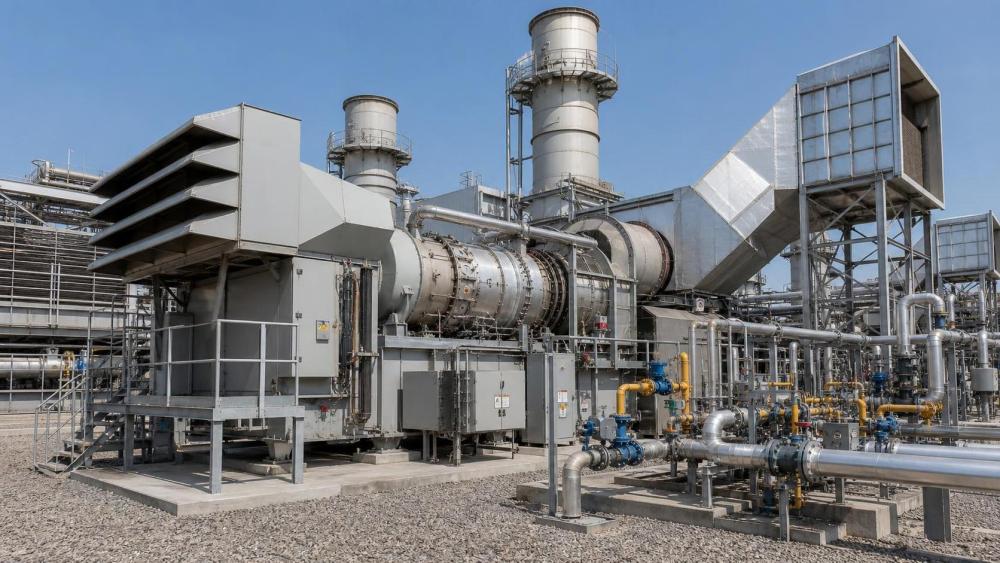
Altitude and site pressure can reshape machine selection
High-altitude sites create a different challenge from hot ambient conditions, though both reduce inlet air mass. Lower site pressure changes compressor operating conditions and can reduce both output and efficiency. In remote mining operations, mountain installations, and some pipeline services, this factor can become decisive before procurement begins.
Altitude correction should not be treated as a simple spreadsheet line item. It affects more than gross power. Starting performance, surge margin, exhaust energy, and cooling effectiveness may all shift. If the application is tied to a process that needs a minimum shaft power or thermal output year-round, site pressure may narrow the range of viable machine classes. This is where reviewing the relevant Gas Turbine configuration against actual site conditions becomes more useful than relying on generic ratings.
Humidity matters, but usually through context
Humidity is less intuitive. In some operating ranges, increased moisture in the inlet air can slightly influence compressor behavior and combustion characteristics. Its effect on output is often smaller than the effect of temperature or altitude, but it should not be ignored where evaporative cooling, fogging, or wet compression strategies are under consideration.
Humidity also matters when corrosion risk, filtration strategy, and fouling tendencies are being assessed. Coastal installations, for example, may be more sensitive to salt ingestion and moisture-related contamination than inland plants. In those settings, the long-term efficiency penalty from deposits and corrosion can outweigh the direct thermodynamic effect of humidity itself.
Part-load operation often decides real fuel economics
Many evaluations still focus too heavily on base-load efficiency, even when the duty profile is highly variable. Yet part-load behavior often has a stronger impact on annual fuel use than the headline full-load value. A turbine that operates most of the year below rated load may show a materially different heat rate curve, response characteristic, and maintenance pattern from what the nominal efficiency suggests.
This issue is especially important in grids with fluctuating renewable generation, industrial plants with changing steam demand, and mechanical drives subject to seasonal throughput. Technical reviewers should ask:
- At what load points will the unit spend most of its operating hours?
- How steep is the efficiency penalty below rated load?
- Are there restrictions on emissions, combustion stability, or cycling at lower loads?
- How quickly can the machine ramp without creating added thermal stress?
A machine optimized for high base-load efficiency may not be the most economical choice if the site requires frequent start-stop cycles or extended operation at mid-load. In those cases, annualized performance matters more than a single reference number.
Fuel composition changes both efficiency and hardware risk
Fuel quality is another major variable, particularly outside standard pipeline natural gas service. Variations in calorific value, Wobbe characteristics, contaminants, liquids carryover, or hydrogen content can alter combustion behavior, turbine firing strategy, emissions, and hot-section life. For liquid fuels, viscosity, cleanliness, and trace metals become additional concerns.
From an evaluation standpoint, the key question is not only whether a turbine can run on a given fuel, but under what derating, maintenance, and emissions conditions. A machine may technically accept a broad fuel range while requiring tighter treatment systems, different combustor hardware, or reduced output when fuel properties move away from the design case.
Fuel flexibility should therefore be reviewed together with the full fuel supply chain: treatment equipment, filtration, storage, switchover logic, startup fuel requirements, and operator procedures. Overlooking these details can turn a theoretical advantage into a recurring reliability problem.
Pressure losses are easy to underestimate during project development
Every pressure drop between ambient air and compressor inlet, and between turbine exhaust and the stack or heat recovery system, consumes performance. Intake filters, silencers, ducting, evaporative media, anti-icing systems, diverter dampers, and heat recovery equipment all add resistance. Individually, these losses may seem modest. Collectively, they can create a meaningful output penalty.
This becomes critical in packaged installations where the turbine itself is only one part of a tightly integrated system. If the performance guarantee boundary is not clearly defined, a project team may discover too late that the expected net power assumed cleaner filters, shorter duct runs, or lower backpressure than the final arrangement provides.
Technical evaluators should verify:
- Whether output is stated as gross or net
- What inlet and exhaust losses are included in the rating basis
- How filter loading and fouling margins are treated
- Whether seasonal degradation has been reflected in performance cases
Compressor fouling and hot-section condition define the real aging curve
Even when the site and fuel are well characterized, output and efficiency drift over time. Compressor fouling reduces airflow and compressor efficiency. Erosion, corrosion, and deposit formation can change blade profiles and cooling effectiveness. Hot-section wear may force operating adjustments before a major outage is due.
For buyers and operators, the practical issue is not whether degradation occurs, but how quickly and how recoverable it is. Some losses can be partially restored with online or offline washing. Others reflect material wear or thermal damage and require more extensive maintenance. The site environment strongly influences this pattern. Dusty air, poor filtration, coastal contaminants, and unstable fuel treatment all accelerate performance decay.
This is why acceptance review should extend beyond day-one output. A technically sound evaluation includes maintainability, wash strategy, access constraints, outage planning, and the quality of condition monitoring data available to the owner. If two machines have similar nominal efficiency, the one with more stable long-term performance under the actual site environment may deliver lower lifecycle fuel cost.
Operating mode changes the meaning of efficiency
Efficiency is not one number. In simple-cycle service, the focus may be electrical heat rate or shaft efficiency. In combined heat and power, useful thermal recovery changes the economic picture. In combined-cycle applications, gas turbine exhaust temperature and mass flow can matter as much as standalone efficiency because they determine downstream steam production.
That distinction affects selection. A machine with slightly lower simple-cycle efficiency may still be attractive if its exhaust characteristics better match the heat recovery steam generator or process steam requirement. Likewise, a mechanical drive unit should be judged against torque response, operating envelope, and reliability under transient load, not only against electric-generation style metrics.
What technical evaluators should ask before comparing machines
Many procurement reviews become difficult because suppliers are asked to compare unlike conditions. A more rigorous screening process starts with a narrow set of operating assumptions that every bidder must use. At minimum, that usually includes:
Without that alignment, performance numbers may look comparable while describing different realities.
The most important condition depends on duty, not on theory alone
If the question is which operating condition matters most, the technical answer is usually ambient temperature for output, and load profile plus degradation behavior for annual efficiency and cost. But the ranking changes with application. High altitude may dominate in mountain sites. Fuel quality may be the key risk in refinery or dual-fuel service. Pressure loss may become decisive in heavily engineered exhaust heat recovery systems.
Strong evaluations avoid one-number comparisons. They test the turbine against the actual operating envelope, the expected maintenance regime, and the physical constraints of the installation. That is where meaningful differences appear: not in the catalog headline, but in how the machine behaves when climate, fuel, load, and system losses stop being ideal.
Related News
- What an intelligence portal for electronics industry should trackSep 18, 2026An intelligence portal for electronics industry tracks technology, demand, supply risks, standards, and competitors—turning complex signals into smarter decisions.
- How electrical engineering for factories prevents costly downtimeSep 16, 2026Electrical engineering for factories helps prevent costly downtime through selective protection, resilient control power, and smarter monitoring. Learn practical strategies now.
- Which inverter technology standards apply to grid-connected systems?Sep 14, 2026Inverter technology standards explained: explore safety, anti-islanding, grid codes, power quality, and certification checks for reliable grid-connected systems.
- What determines the required switchgear fault withstand rating?Sep 13, 2026Switchgear fault withstand rating explained: learn how fault current, clearing time, network configuration, and future expansion shape safe, cost-effective selection.
Related News
- 00
0000-00
How to verify suppliers listed in a power system supplier directory - 00
0000-00
What an intelligence portal for electronics industry should track - 00
0000-00
What to verify before choosing an energy storage system supplier - 00
0000-00
How electrical engineering for factories prevents costly downtime - 00
0000-00
When does a smart grid for buildings reduce peak demand charges?