
The GCC induction motor market is not simply moving toward “more efficient” equipment. Demand is becoming more selective: projects increasingly distinguish between a motor’s nominal efficiency class, its performance at the real duty point, its compatibility with variable-speed control, and the commercial credibility of the efficiency claim.
This matters because electricity cost, operating hours, ambient temperature, process criticality, and asset-life expectations differ sharply across the region’s water, oil and gas, HVAC, petrochemical, manufacturing, logistics, and infrastructure applications. An IE3 motor may be commercially sufficient for one continuously loaded pump, while an IE4 solution can be justified for another only when the load profile, control system, and maintenance strategy support its higher initial cost. The market shift is therefore toward lifecycle-based procurement rather than a universal race for the highest nameplate grade.
Efficiency grades are becoming a commercial screening criterion
For low-voltage, line-operated AC motors, IEC 60034-30-1 provides the widely recognized International Efficiency classification framework, including IE2, IE3, and IE4 efficiency levels for covered motor types and ratings. In commercial discussions, these labels have become useful shorthand. They allow consultants, EPC contractors, plant owners, and suppliers to establish a minimum technical threshold before comparing prices, delivery terms, documentation, and service capability.
That shorthand is valuable, but it can also obscure important differences. An efficiency class is not a complete statement of operating economy. It is determined under defined test conditions and applies to a particular motor design, power rating, pole number, and frequency. A motor selected for a lightly loaded duty, poor power-quality environment, unsuitable enclosure, or frequent start-stop cycle may not deliver the expected energy outcome merely because its catalog rating is higher.
In the GCC induction motor market, this distinction is becoming more important as procurement shifts from basic replacement buying toward system modernization. Existing installations often include motors operating beyond their original design horizon, fixed-speed pumping or fan systems, and equipment packages assembled around price-led specifications. When these assets are refurbished, the motor is being evaluated as part of a broader operating-cost decision.
The practical result is a more segmented market:
- IE2 equipment remains relevant in replacement situations where specifications permit it, capital limits are strict, or the duty is intermittent and energy savings are limited.
- IE3 equipment is increasingly treated as the reference point for new industrial-duty installations where efficiency requirements are formalized in tenders or internal engineering standards.
- IE4 equipment attracts attention in long-running, energy-intensive applications, but its business case depends on verified operating hours, load factor, electricity pricing, and the availability of an appropriate motor-drive package.
These categories should not be interpreted as a fixed regional adoption sequence. Individual national regulations, utility requirements, consultant specifications, and owner standards can differ. In many projects, the decisive requirement is not a broad market rule but a project document requiring compliance with a specified IEC class, test method, or approved-vendor framework.
Why the GCC operating environment makes the calculation more demanding
A motor’s efficiency grade is only one part of its suitability for GCC service conditions. High ambient temperatures, dust exposure, humidity in coastal areas, corrosive atmospheres in selected industrial zones, unstable process loading, and a high dependence on cooling and pumping systems all affect the selection logic.
Temperature is especially important. Motor efficiency is normally declared under standardized conditions, while actual winding temperature and losses rise as ambient conditions and loading become more severe. A motor that appears attractive on a nominal efficiency comparison may require derating or a different insulation, cooling, or enclosure arrangement in a high-temperature installation. If that issue is ignored, the purchaser can end up comparing catalog efficiency figures while underestimating thermal margin and reliability risk.
The same applies to ingress protection and enclosure construction. In dusty environments, cooling-path blockage can raise operating temperature. In coastal and marine-adjacent facilities, corrosion resistance, coating systems, terminal box protection, and fastener quality may carry more operational value than a small difference in stated efficiency. A high-efficiency motor with insufficient environmental protection is not a premium asset; it is a maintenance exposure.
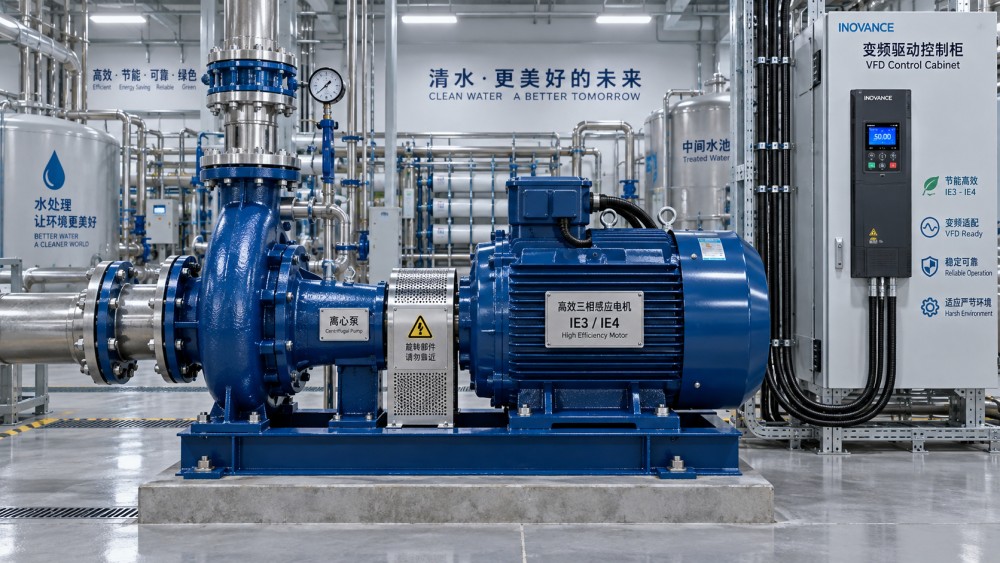
For water and wastewater projects, another factor is often more decisive than the motor grade itself: the pump operating point. A correctly selected pump and variable frequency drive can reduce energy consumption far more materially than replacing one compliant motor grade with the next while retaining inefficient throttling, bypass operation, or poor hydraulic matching. The motor market is therefore increasingly linked to system-level efficiency assessments, especially in tender packages involving pumps, fans, compressors, and air-handling equipment.
Variable-speed drives are changing how motor value is assessed
The rising use of variable frequency drives changes the commercial meaning of “efficient motor.” At fixed speed and near rated load, an IE3 or IE4 motor comparison may be relatively straightforward. Under inverter-fed operation, however, the buyer must consider the complete motor-drive system.
Drive-fed service can introduce additional losses, voltage stress at motor terminals, bearing-current risk, acoustic noise, and cooling limitations at low speed. These effects do not invalidate the use of high-efficiency induction motors, but they mean the motor cannot be assessed independently from the inverter, cable length, switching characteristics, duty cycle, and required speed range.
A specification that merely says “IE3 motor with VFD” leaves important questions unanswered. Commercially robust specifications clarify whether the motor is designed for inverter duty, whether it requires insulated bearings or shaft grounding provisions, which thermal protection is included, the permitted speed range, and the expected torque profile. They also identify whether a separate forced-ventilation arrangement is needed when the motor must deliver high torque at low speed.
This is particularly relevant in GCC modernization work. A legacy motor replaced with a high-efficiency model may perform well on direct-on-line duty but behave differently after a VFD retrofit. Conversely, a drive package can create substantial process savings in fan and centrifugal pump applications, yet offer limited benefit where speed must remain effectively constant. The economic case should start with the load characteristic, not with the assumption that variable speed is automatically advantageous.
The shift is strongest where energy use is visible and controllable
Not every motor population will transition at the same pace. The clearest demand for higher efficiency grades is likely to come from applications where energy consumption is measurable, operation is prolonged, and asset owners can connect equipment decisions to operating budgets.
Continuous-duty pumps, ventilation systems, chilled-water circulation, industrial fans, conveyor systems, and selected compressor applications fit this profile. Their motor fleets may be numerous, their run hours substantial, and their energy usage sufficiently concentrated to justify engineering review. In contrast, standby equipment, lightly used actuators, short-duty machines, and certain specialized process drives may not support the same payback logic.
This distinction has consequences for market evaluation. A rising number of projects specifying IE3 or IE4 motors does not mean every replacement sale will move into the premium segment. Replacement markets remain shaped by interchangeability, frame dimensions, shaft geometry, mounting arrangement, delivery urgency, installed control method, and available maintenance inventory. In a shutdown-driven replacement, exact fit and dependable lead time can outweigh a higher efficiency option that requires mechanical changes or extended approval.
New-build industrial and infrastructure projects offer a different pathway. When motor requirements are incorporated early into package specifications, suppliers can align efficiency class, enclosure, hazardous-area requirements where applicable, insulation system, terminal arrangement, and drive compatibility before procurement pressure narrows the choices. This is where efficiency grade increasingly functions as a baseline qualification condition rather than an optional upgrade.
Compliance claims require more scrutiny than catalog labels
As efficiency grades become more commercially important, documentation quality becomes part of supplier assessment. The key question is not whether a catalog carries an IE label, but whether the offered motor’s rating, construction, and test basis support the claim for the exact configuration being supplied.
IEC 60034-2-1 is commonly referenced for methods of determining losses and efficiency in rotating electrical machines. A buyer does not need to reproduce laboratory testing, but should be able to trace the declared efficiency to a credible technical file. This becomes particularly relevant when evaluating unfamiliar brands, private-label products, or quotations with unusually aggressive price positioning.
A related risk lies in comparing purchase prices without normalizing scope. One quotation may include PTC thermistors, tropicalized winding protection, premium bearings, a higher ingress-protection rating, or inverter-duty insulation, while another may quote only the basic motor. If the first offer is judged solely against the second motor’s unit price, the efficiency comparison becomes commercially misleading.
Lifecycle cost is useful only when built on real operating assumptions
The logic behind higher efficiency grades is straightforward: lower losses reduce electricity consumption. The business calculation, however, is often weakened by unrealistic assumptions. A lifecycle model should use the expected annual run hours, average motor loading, local tariff structure or internal energy valuation, planned maintenance horizon, and the incremental cost of the alternative motor.
Motor loading deserves particular attention. Induction motors often operate away from their rated point because the original equipment was oversized to provide contingency, accommodate uncertain process conditions, or simplify standardization. Higher-efficiency motors still reduce losses, but a model based on full-load, continuous operation can materially overstate the savings if the real load is modest or variable.
The reverse problem also occurs. A motor that regularly runs near overload may consume more energy and experience greater thermal stress than assumed in procurement calculations. In such cases, correcting the sizing and process conditions can be more valuable than upgrading the efficiency grade alone.
For commercially sensitive projects, the strongest approach is to separate three values: the motor’s purchase premium, its estimated energy-loss reduction under stated assumptions, and the avoided operational risk associated with thermal margin, reliability, and service support. These are not interchangeable benefits. Energy savings can be modeled; reliability benefits require more cautious treatment and should not be converted into speculative financial figures without evidence from the specific asset environment.
Supplier positioning will depend on engineering support as much as grade availability
The market transition creates an opening for manufacturers able to supply IE3 and IE4 products, but grade availability alone is unlikely to secure durable positioning. Suppliers will be judged on whether they can provide consistent data sheets, matching technical documentation, frame and mounting options, regional voltage configurations, spare-part continuity, and credible after-sales support.
For distributors and importers, portfolio management becomes more complex. Carrying only low-cost standard motors can weaken eligibility for projects with explicit efficiency specifications. Stocking only premium grades can create inventory risk where replacement demand remains price-sensitive or mechanically constrained. The practical opportunity lies in maintaining a clearly segmented range and knowing where each segment fits: standard replacement, specification-led industrial supply, VFD-compatible applications, and harsh-environment duty.
For project owners, the central judgment is whether the motor requirement is connected to the operating reality of the driven equipment. A blanket instruction to procure the highest available efficiency grade may create cost without proportional return. A lowest-price approach can lock in avoidable energy losses or prematurely narrow maintenance margins. The more resilient procurement position is to define the required efficiency class, then verify that the selected motor is appropriately sized, environmentally suitable, compatible with the control method, and supported by documentation that can withstand project approval and operational scrutiny.
The GCC induction motor market is therefore moving toward efficiency grades as a decision framework, not as a standalone purchasing badge. The winners in this transition will be the motor packages that turn a declared IE level into a credible operating proposition: correct duty, verified performance, suitable protection, manageable lifecycle cost, and reliable availability when the installation requires it.
Related News
- GCC induction motor market demand is shifting toward efficiency gradesSep 21, 2026GCC induction motor market demand is shifting toward IE3 and IE4 efficiency grades. Explore lifecycle cost, VFD compatibility, compliance, and smart sourcing.
- Are 2026 Carbon Policy Changes Likely to Affect Green Energy Bids?Sep 11, 2026Are carbon policy changes likely to affect green energy bids? Explore 2026 risks in carbon costs, CBAM, incentives, supply chains, and bid compliance.
- What makes an intelligence portal high-authority for market research?Aug 30, 2026Discover what makes a high-authority intelligence portal reliable: traceable market insights, engineering context, source governance, and supply-chain clarity.
- What is driving investment in international infrastructure development?Aug 28, 2026International infrastructure development is accelerating through electrification, grid resilience, decarbonization, and industrial growth. Discover what drives bankable projects.
Related News
- 00
0000-00
GCC induction motor market demand is shifting toward efficiency grades - 00
0000-00
How portal transformers protect power equipment from voltage surges - 00
0000-00
What grid standards consultants should verify before a grid connection - 00
0000-00
How to verify suppliers listed in a power system supplier directory - 00
0000-00
What an intelligence portal for electronics industry should track