
A utility replaces aging feeder automation equipment in one district, adds distributed solar monitoring in another, and deploys a new advanced metering system across its service territory. On paper, each project improves visibility. In practice, the control room may soon be managing several data models, overlapping communication networks, different cybersecurity assumptions, and device alarms that do not mean the same thing.
That is why the question “Can smart grid devices from different suppliers interoperate?” matters far beyond procurement. The short answer is yes—but not automatically. Smart meters, protection relays, reclosers, inverter controllers, switchgear, SCADA platforms, energy management systems, and edge gateways can work together when interoperability is designed into the architecture, contract requirements, testing process, and long-term operating model.
Interoperability is not achieved simply because two products support Ethernet, use an IP address, or display the word “open” in a brochure. A connected grid must exchange the right data, interpret it consistently, perform actions safely, remain secure during upgrades, and preserve operational accountability when something goes wrong.
Interoperability Has More Than One Meaning
Many integration projects fail because stakeholders use the word “interoperable” to describe different expectations. A field device may connect to a network successfully while still being unable to provide usable information to a control application. Likewise, a platform may read a device status but be unable to issue a secure control command or retrieve disturbance records in a meaningful format.
For a modern power system, interoperability generally has five connected layers:
- Physical and network connectivity: Devices can communicate across copper, fiber, cellular, radio, or local area networks using compatible interfaces and transport methods.
- Protocol interoperability: Systems use recognized communications protocols to exchange messages, events, measurements, and commands.
- Semantic interoperability: Both sides understand what the data means. A “trip,” “open,” “blocked,” or “quality flag” must carry the same operational interpretation.
- Functional interoperability: Devices and software can coordinate actual grid functions, such as fault isolation, voltage regulation, demand response, or distributed energy resource control.
- Lifecycle interoperability: The integration survives firmware updates, device replacement, cybersecurity patches, vendor changes, and evolving grid requirements.
The first two layers are often manageable. The last three are where utilities, industrial operators, and infrastructure developers encounter the most expensive surprises.
Standards Create a Common Language—But They Do Not Eliminate Engineering Work
Open standards are the strongest foundation for multi-supplier smart grid environments. Their purpose is not to force every manufacturer to build identical equipment; rather, they define a shared way for diverse equipment to communicate and describe operational information.
In substation automation, IEC 61850 is central to interoperability discussions. It provides communication services and a structured data model for intelligent electronic devices, including protection relays, bay controllers, and switchgear automation systems. Its value lies in more than message transport: it creates a common vocabulary for electrical functions, logical nodes, events, and datasets.
For control-center and distribution automation integration, IEC 60870-5-104 and DNP3 remain widely used, especially where legacy systems coexist with new intelligent field assets. In North American and international utility contexts, DNP3 is familiar for reliable telemetry and control over constrained communications links. Modbus continues to appear in industrial and renewable energy applications, although its simpler data structure often requires additional mapping and careful security treatment.
At the enterprise level, the Common Information Model (CIM), represented through IEC 61970 and IEC 61968 families, helps different planning, operations, market, outage, and asset-management applications share consistent representations of the grid. For distributed energy resources, standards such as IEEE 1547 define key interconnection and grid-support expectations, while communications profiles may vary by regional market and application.
Yet standards compliance is not a guarantee of plug-and-play operation. Two devices may both claim IEC 61850 support while implementing different editions, optional functions, naming conventions, engineering tools, or proprietary extensions. The practical question is not “Does it support the standard?” It is “Which parts of the standard are implemented, how are they configured, and have they been validated in the intended use case?”
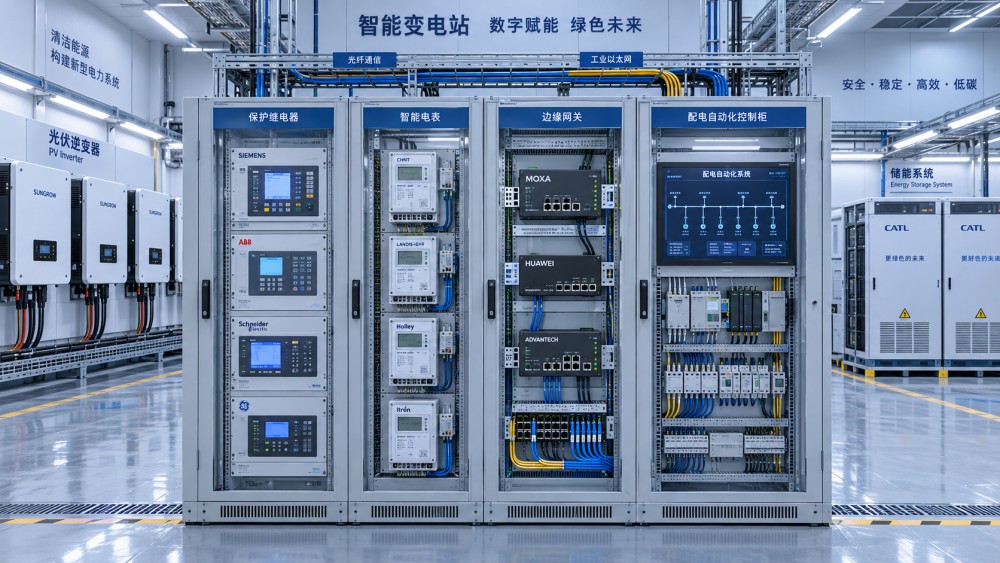
Where Multi-Vendor Smart Grid Integration Usually Breaks Down
The most visible problem is often protocol mismatch, but it is rarely the only one. A gateway can translate one protocol into another; it cannot always preserve timing, data quality, event sequence, control authority, or cybersecurity context. Translation may solve connectivity while quietly creating operational ambiguity.
Different data models and point naming
One supplier may expose a breaker position as a simple binary point. Another may distinguish between open, closed, intermediate, invalid, maintenance, local control, and communication failure. If those states are compressed into a basic SCADA point list, operators can lose context precisely when they need it most.
Point naming also becomes difficult at scale. A single feeder is manageable by hand. Thousands of devices across substations, renewable sites, and customer-edge assets require disciplined naming, asset identifiers, time synchronization, and master data governance.
Control logic at competing layers
Smart grids increasingly distribute intelligence. A recloser has local protection logic. A feeder automation controller may coordinate sectionalizing. The distribution management system may optimize switching. Inverter fleets may respond to voltage or frequency conditions locally, while a DER management system sends fleet-level setpoints.
Without a clear hierarchy, these controls can conflict. A local device may act faster than a central system expects; a central optimization command may override a safety-related setting; two platforms may believe they own the same controllable point. Interoperability therefore includes governance: who has authority, under what conditions, and how is that authority transferred?
Cybersecurity assumptions that do not align
Multi-vendor environments introduce different certificate handling methods, authentication capabilities, patch cycles, remote-access tools, and logging formats. An older device may not support modern encryption or role-based access controls. A newer device may require them. Connecting both to the same operational environment without segmentation can expose a much larger attack surface.
Cybersecurity must be specified as an interoperability requirement, not handled as an afterthought. Secure communication profiles, identity management, network zoning, monitoring, incident logging, and patch responsibilities should be agreed before deployment.
Firmware changes and opaque dependencies
Even a stable integration can drift over time. A firmware upgrade may alter a register map, introduce a new certificate requirement, change a protocol stack, or remove an older feature. If the interface depends on undocumented behavior, a routine maintenance event can become an operational incident.
A Better Way to Evaluate Interoperability Before Purchase
Procurement teams often compare device specifications line by line. That is necessary, but it is not enough. A stronger approach begins with real operating scenarios rather than product categories. Ask what must happen during a fault, a communication loss, a planned switching operation, a DER curtailment event, or a cyber incident.
For each scenario, define the required source of truth, response time, data quality, control permissions, fallback mode, audit trail, and recovery procedure. This turns a vague request for “integration capability” into a testable engineering requirement.
A useful contract should require interface documentation, conformance evidence where applicable, access to configuration artifacts, change-notification procedures, and acceptance tests based on the utility’s own operational scenarios. It should also distinguish between “communication established” and “functional interoperability demonstrated.” Those are not the same milestone.
Build an Integration Architecture, Not a Collection of Connections
There is a temptation to solve every compatibility issue with a gateway. Gateways are valuable, especially when utilities must extend the life of legacy relays, meters, or industrial controllers. But an architecture built entirely on protocol conversion becomes hard to troubleshoot and harder to secure.
A more resilient approach separates field, edge, operational technology, and enterprise layers while defining the interfaces between them. Field devices should retain essential protection and safety functions locally. Edge systems can normalize data, enforce secure connectivity, and continue limited functions during communications disruption. SCADA, DMS, DERMS, and asset platforms should receive information through governed interfaces rather than direct, uncontrolled device connections.
This design also supports gradual modernization. Utilities do not need to replace every installed asset to gain interoperability. They can prioritize high-value interfaces, use secure adapters where appropriate, standardize new procurements, and retire fragile integrations over time. The objective is not a perfectly uniform grid; it is a grid whose diversity remains understandable and controllable.
Testing Must Resemble the Real Grid
Laboratory conformance testing is important, but it cannot replicate every condition of a live system. A device may pass an interface test yet behave unexpectedly when communication latency rises, GPS time is lost, a redundant server fails over, or multiple control applications issue commands during a restoration event.
Before commissioning, integration testing should include normal operations and uncomfortable conditions: bad-quality telemetry, stale timestamps, duplicate messages, dropped packets, loss of a gateway, invalid certificates, device reboot, local control takeover, and restoration after a network outage. For protection and automation functions, test engineers should verify sequence-of-events accuracy and confirm that command acknowledgements truly reflect field execution.
Factory acceptance testing can validate configured equipment before shipment. Site acceptance testing confirms field wiring, communications, and local operating behavior. For complex programs, a staging environment or digital replica can reduce risk when applying upgrades. The discipline may feel slow during a project schedule, but it is far less disruptive than discovering hidden dependencies during a storm response or a high-load event.
Interoperability Is Especially Important for DER and Electrification
The growth of solar, battery storage, electric vehicle charging, heat pumps, and flexible industrial loads changes the nature of grid coordination. These assets are often deployed quickly, sourced from different manufacturers, and connected at the distribution edge—where visibility has historically been limited.
In this environment, interoperability affects whether an operator can observe inverter status, apply approved grid-support settings, coordinate charging demand, validate compliance, and respond to abnormal conditions without manually navigating several vendor portals. It also determines whether distributed flexibility can become a dependable grid resource rather than a collection of isolated assets.
For project developers and industrial energy users, the same principle applies. Selecting a lower-cost controller or inverter without considering data access, control interfaces, and future platform compatibility may create a more expensive operating burden later. Hardware costs are visible at purchase; integration costs often emerge only when assets need to scale, report, or participate in grid programs.
What “Good Enough” Looks Like
Not every device needs deep, bidirectional integration. A basic environmental sensor may only need secure reporting. A protection relay may require high-fidelity event exchange and carefully governed control. A battery fleet may need both local autonomy and dispatch coordination. The right target depends on the operational consequence of failure.
Good interoperability is therefore proportional and intentional. It gives operators reliable data without drowning them in unnecessary points. It preserves local protection and safety. It avoids dependence on undocumented interfaces. It makes cybersecurity responsibilities visible. Above all, it allows the grid to evolve without forcing every new device to come from the same supplier.
For decision-makers following the digital grid transition, this is the practical lesson: multi-vendor smart grid interoperability is achievable when standards, data governance, cybersecurity, testing, and lifecycle planning are treated as one engineering discipline. At GPEGM, the changing relationship between power equipment, automation architecture, and energy transition remains a central area of analysis—because the future grid will not be built from one technology stack, but from many systems that must learn to work together.
Related News
- Can Smart Grid Devices from Different Suppliers Interoperate?Sep 26, 2026Can smart grid devices from different suppliers interoperate? Explore standards, cybersecurity, testing, and practical strategies for reliable multi-vendor grid integration.
- What grid standards consultants should verify before a grid connectionSep 20, 2026Grid standards consultants: verify protection, power quality, controls, metering, and compliance evidence before connection to prevent delays and achieve smoother energization.
- When does a smart grid for buildings reduce peak demand charges?Sep 15, 2026Smart grid for buildings: learn when peak shaving cuts demand charges, how tariffs, flexible loads, batteries, and reliable controls shape a stronger ROI.
- How Often Should Industrial Circuit Breakers Be Tested?Sep 14, 2026How often should industrial circuit breakers be tested? Explore risk-based intervals, essential test methods, and maintenance practices to improve safety, reliability, and uptime.
Related News
- 00
0000-00
How to size power equipment for factories without overbuilding capacity - 00
0000-00
How efficiency evolution in automation is reshaping factory energy use - 00
0000-00
When market scanning services are worth the investment - 00
0000-00
Which international infrastructure projects are reshaping Southeast Asia? - 00
0000-00
What drives power pricing in long-term supply contracts?