
An IE4 AC motor can be worth the higher purchase price, but only when the operating profile gives its efficiency advantage enough time to earn back the premium. For a motor that runs continuously, carries a meaningful load, and is expected to remain in service for years, the decision often favors IE4. For an intermittently used motor, an oversized motor, or a machine approaching replacement, the case may be weak even if IE4 is technically the better product.
The purchase decision should therefore begin with annual energy use and system duty, not with the motor nameplate alone. An IE4 rating signals very high efficiency under the applicable motor-efficiency standard, but it does not guarantee a proportionate reduction in a facility's total electricity bill. The financial result depends on load, operating hours, electricity cost, control method, mechanical condition, and whether the motor is correctly matched to the driven equipment.
Start with the cost of energy, not the cost of the motor
In many industrial installations, electricity consumed over a motor's working life is far more important than its initial purchase price. That does not make every IE4 motor an automatic purchase. It does mean that the price difference should be assessed against the energy consumed during the period the asset is expected to operate.
The efficiency gap between an IE3 and an IE4 motor may appear modest on a datasheet. Yet a small percentage improvement applied to a motor running many hours each year can produce a material energy saving. The same improvement has limited economic value on a standby pump, an intermittently operated conveyor, or a low-utilization workshop machine.
A practical comparison needs a few site-specific inputs:
- Motor rated power and expected average shaft load
- Actual annual operating hours, including weekends and seasonal production changes
- Electricity tariff, including demand-related charges where relevant
- Expected service life before the machine, process, or drive system is replaced
- Efficiency at the likely operating load, not only at full-load conditions
- The net installed cost, including controls, mechanical changes, commissioning, and spares
For a first-pass calculation, annual energy input can be estimated by dividing mechanical output by motor efficiency and multiplying by operating hours. Comparing that result for the proposed IE4 motor and the existing alternative gives an estimated annual energy difference. The additional installed cost divided by annual savings provides a simple payback indication.
That calculation should be treated as a screen, not a final investment case. It can overlook downtime exposure, maintenance strategy, production constraints, process losses, and future energy-price risk. Still, it prevents a common procurement mistake: approving or rejecting an IE4 motor purely on its purchase-price premium.
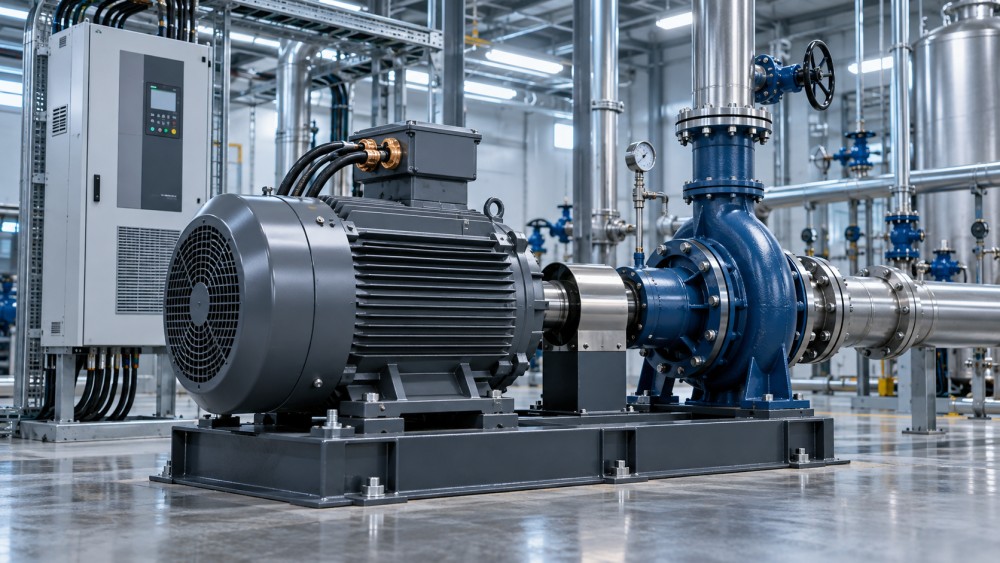
Where the IE4 premium is most likely to pay back
The strongest cases tend to be predictable, energy-intensive duties. Continuous process pumps, ventilation systems, air-handling equipment, cooling-water circuits, compressors, conveyors, and process fans are common examples. These applications may operate for long periods at stable or moderately variable loads, making even small efficiency gains cumulative.
Motors in remote, difficult-to-access, or high-downtime locations can also justify a higher initial outlay. The energy benefit matters, but it is not the only consideration. A purchaser may place value on a motor platform with appropriate reliability characteristics, available documentation, compatible protection arrangements, and a credible replacement path. The efficiency class alone does not establish those qualities, but a high-efficiency procurement exercise can be a useful point to review them.
IE4 can be particularly attractive when it is part of a wider drive-system decision. A motor on a pump or fan may be paired with a variable frequency drive to regulate flow or pressure rather than relying on throttling, bypassing, or fixed-speed cycling. In those cases, the largest savings often come from better process control and reduced mechanical losses. The IE4 motor improves the motor portion of the equation; it should not be presented as the sole source of system-level savings.
For replacement projects, timing matters. A failed motor on a high-hour production asset may create a narrow decision window. If IE4 compatibility has not been reviewed in advance, the operation may default to the fastest available replacement rather than the best lifecycle choice. Establishing approved motor families for critical applications can avoid that rush.
A higher efficiency class does not correct a poor application
An IE4 motor can disappoint when the underlying system is inefficient or the motor is poorly selected. Installing it on an oversized pump, a badly throttled fan, a misaligned conveyor, or a machine with chronic mechanical losses may reduce input power somewhat, but it will not solve the primary source of waste.
Oversizing deserves special attention. Motors are sometimes selected with generous capacity margins to accommodate uncertainty, starting demands, or future expansion. A motor operating far below its intended load can deliver an unfavorable combination of efficiency, power factor, and capital cost. Moving to IE4 without reassessing the required shaft power may preserve the same mismatch at a higher price.
Starting and load behavior also matter. A direct-on-line start, high-inertia load, frequent reversing duty, or demanding torque profile may limit suitable motor options. The purchaser should confirm torque-speed characteristics, starting current, thermal performance, rotor design, enclosure, and service factor requirements rather than assuming one efficiency class is interchangeable with another.
At smaller frame sizes or lower annual operating hours, the premium can take longer to recover. This is not evidence that IE4 is inferior; it is an indication that lifecycle economics are application-specific. A low-duty actuator, emergency-service motor, or lightly used maintenance machine may reasonably be specified to a different efficiency level if performance, regulatory requirements, and site standards permit.
Variable frequency drives need a separate compatibility check
Many IE4 motors are installed with variable frequency drives, and that pairing can be highly effective. It also introduces design questions that are not answered by an efficiency label.
Drive-fed operation can expose the motor insulation system to fast voltage transitions. Cable length, switching frequency, output filtering, grounding practice, motor terminal conditions, and the inverter design all influence electrical stress. Bearing currents are another concern in some arrangements, particularly on larger machines or where the installation has poor grounding and common-mode voltage is not adequately managed.
The buyer should establish whether the motor is intended for inverter duty across the required speed range. Relevant information includes:
- Permitted torque capability at low speed
- Cooling method and allowable derating below base speed
- Maximum operating speed and mechanical limits
- Insulation system suitability for the selected drive and cable arrangement
- Need for insulated bearings, grounding rings, filters, or other mitigation
- Efficiency data at the speeds and loads that the process will actually use
A self-cooled motor may run hotter at low speed because its shaft-mounted fan also slows down. If the driven process requires sustained torque at reduced speed, forced ventilation or a different motor configuration may be required. In contrast, centrifugal pump and fan loads often reduce torque demand as speed falls, which can make variable-speed operation more favorable. The duty curve, rather than a generic assumption about VFD operation, should shape the specification.
Do not compare nameplate efficiency in isolation
A sound comparison places the motor inside the complete operating system. The relevant question is not simply whether IE4 is more efficient than a lower class at rated conditions. It is whether the proposed arrangement reduces total cost and operational risk over the intended service period.
For a pump, review the pump curve, expected flow range, control valve position, static head, pipe losses, and operating point. For a fan, look at damper control, pressure setpoints, duct leakage, and seasonal duty. For conveyors and production machinery, consider average torque, idle running, acceleration cycles, and stop-start frequency. These checks can reveal larger opportunities than the incremental motor-efficiency improvement alone.
There is also a distinction between replacing a failed motor and redesigning a working system. An emergency replacement should prioritize technical fit, availability, and safe restoration of service. A planned upgrade has more room to evaluate rightsizing, VFD integration, mechanical corrections, and revised controls. Treating both events as identical procurement exercises can lead either to unnecessary delay or to a missed energy-saving opportunity.
What buyers should ask suppliers and internal stakeholders
Procurement specifications should be specific enough to avoid substitutions that meet the nominal efficiency class but do not fit the application. Asking for an IE4 motor without defining the operating environment, control method, mounting arrangement, and duty can transfer too much engineering risk into the delivery and commissioning stage.
Before issuing an order, align maintenance, operations, electrical engineering, and purchasing around a short set of questions:
- What is the measured or credible expected load profile?
- How many hours will the motor operate each year?
- Will it run direct-on-line, soft-started, or from a variable frequency drive?
- Does the selected motor match the required speed, torque, enclosure, mounting, and hazardous-area conditions where applicable?
- Will dimensions, shaft height, coupling, baseplate, cable terminations, and protective devices fit without rework?
- What efficiency values apply at the operating point, and what assumptions are behind the savings estimate?
- Are repair, spare-holding, lead-time, and standardization implications acceptable for the site?
The final point is often underestimated. A facility with a small number of motor platforms can simplify stocking, maintenance procedures, training, and emergency replacement. Conversely, a highly specialized IE4 motor with a long lead time may create an availability concern for a critical asset. The right response may be to hold a spare, approve an equivalent replacement route, or apply the specification only to planned projects rather than every motor position.
Use lifecycle value as the decision rule
An IE4 AC motor is usually worth its higher purchase price when it will run enough hours, at a suitable load, in a system that is already reasonably well matched to the process. The argument becomes stronger where electricity costs are significant, decarbonization reporting places value on lower energy use, or a scheduled upgrade can combine the motor with better speed control and system optimization.
It is less compelling where duty is low, the machine is oversized or near retirement, the operational load is uncertain, or the installation creates compatibility costs that outweigh likely energy savings. In those circumstances, the right decision may be a lower efficiency class, a rightsized motor, a VFD-led system redesign, or simply a better understanding of the load before capital is committed.
The most defensible purchase decision is therefore not “always buy IE4” or “avoid the premium.” It is a documented lifecycle comparison using the motor's real duty, the system's real losses, and the site's real operating constraints. That approach gives engineering teams a clearer basis for spending more where efficiency will genuinely deliver value.
Related News
- What drives power pricing in long-term supply contracts?Sep 22, 2026Power driving price in long-term supply contracts: explore fuel, grid, regulation, load shape, and risk allocation to make smarter energy buying decisions.
- Is an IE4 AC Motor Worth the Higher Purchase Price?Sep 23, 2026Is an IE4 AC motor worth the higher purchase price? Compare energy savings, payback, VFD compatibility, and lifecycle value to make a smarter investment decision.
- How Do I Calculate Inverter Cost Including Maintenance?Sep 18, 2026How do I calculate inverter cost including maintenance? Compare installation, service, efficiency losses, downtime, replacement costs, and lifecycle value.
- What drives energy intelligence pricing for enterprise deployments?Sep 07, 2026Energy intelligence pricing varies by coverage, data quality, alerts, analysis, integration, and customization. Learn how to compare enterprise options and maximize decision value.
Related News
- 00
0000-00
When market scanning services are worth the investment - 00
0000-00
Which international infrastructure projects are reshaping Southeast Asia? - 00
0000-00
What drives power pricing in long-term supply contracts? - 00
0000-00
Is an IE4 AC Motor Worth the Higher Purchase Price? - 00
0000-00
Can One Motor Controller Support Different Motor Loads?