
Procurement teams rarely struggle to compare gas turbine suppliers on headline specifications alone. The harder questions appear once a project moves from technical interest to purchasing risk: how long will delivery really take, what testing is included before shipment, and whether the documentation package will support installation, commissioning, customs clearance, and later maintenance. A supplier that looks competitive on paper can become expensive if lead times slip, factory tests are narrowly defined, or records arrive incomplete.
For buyers, these three areas are linked. Lead time affects outage planning, project cash flow, and contract penalties. Testing affects whether problems are found in the factory or after installation. Documentation affects how quickly equipment can be accepted, integrated, and maintained. Looking at them separately often hides where cost and schedule risk actually sits.
Why supplier evaluation goes beyond quoted delivery dates
A quoted lead time for a turbine package can sound straightforward, but procurement teams need to know what that date includes and what it does not. In many applications, the calendar starts only after design approval, receipt of deposit, confirmation of technical deviations, or finalization of auxiliary system scope. If those conditions are not clear, a “20-week lead time” from one supplier may not be comparable to “20 weeks” from another.
Several factors commonly influence the real delivery window:
- Whether the unit is a standard configuration or requires customization for fuel type, ambient conditions, emissions controls, or control system integration
- Availability of long-cycle components such as rotors, blades, combustor parts, instrumentation, and certain alloy castings
- Whether skids, enclosures, filters, lube oil systems, or generators are supplied in-house or sourced from third parties
- The level of witness testing requested by the buyer or end user
- Export packing, shipping arrangements, and document legalization requirements
For a procurement specialist, the practical question is not only “When can you ship?” but “What has to happen before shipment is possible?” Suppliers should be able to break the schedule into engineering release, material procurement, manufacturing, assembly, testing, preservation, and document handover. A detailed schedule reveals where the critical path sits. If the vendor cannot explain the schedule logic, the promised date may be more commercial than operational.
How to read lead time risk in a gas turbine quotation
Buyers comparing suppliers for a Gas Turbine should watch for soft spots hidden inside otherwise complete quotations. One common issue is partial scope. A supplier may quote the core turbine quickly, while the delivery of auxiliary packages, starter systems, fuel skids, inlet treatment, exhaust components, or control panels follows a different timeline. In practice, site installation cannot move at the pace of the fastest component; it moves at the pace of the slowest one.
Another issue is substitution flexibility. Some suppliers maintain broader approved vendor lists for electrical and instrumentation items, which can reduce shortages. Others depend on a narrow chain of preferred sources. Neither model is automatically better, but procurement teams should ask how equivalent parts are controlled, what happens when an item becomes unavailable, and whether substitutions require buyer approval.
Lead time should also be tied to change management. Late engineering changes from the customer can extend the schedule, but frequent vendor-side revisions can do the same. Ask for a drawing and document register with issue dates. If major interface drawings appear late, civil, piping, and electrical work may stall even if the turbine itself is physically ready.
Good supplier evaluation also considers serviceability after delivery. A short manufacturing lead time has limited value if commissioning engineers, spare parts, or field technical support are difficult to mobilize. Procurement teams often separate capex from service planning, yet the handover phase can become the most expensive point of delay.
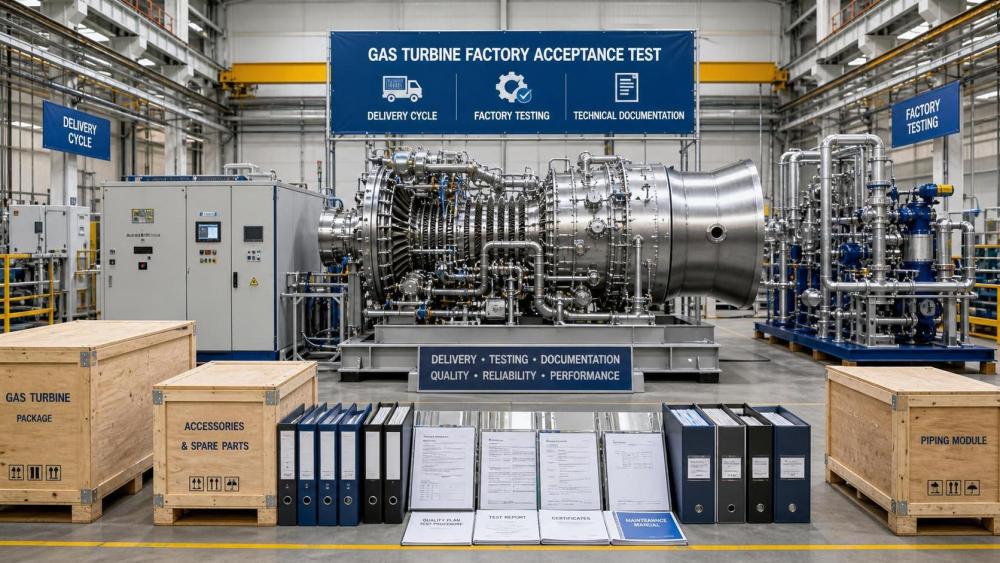
Testing is not a formality; it is where commercial risk becomes visible
Factory testing can vary widely between suppliers even when both claim full compliance with the purchase specification. Buyers should not assume that “tested before shipment” means the same thing in every quotation. Some packages undergo only basic mechanical checks and instrument verification. Others include rotational tests, control logic validation, vibration checks, pressure tests for auxiliaries, and performance verification under defined conditions.
The key procurement task is to compare test scope, not just the existence of a test. Questions worth asking include:
- Is the turbine tested as a stand-alone machine or as part of a package with controls and auxiliaries?
- Are witness points defined for the buyer, consultant, or end user?
- Which alarms, trips, and interlocks are simulated and recorded?
- Will the test confirm mechanical integrity only, or also operating behavior across load points?
- How are nonconformities documented, corrected, and re-tested?
Testing matters because the cost of detecting a problem changes dramatically depending on timing. A control logic mismatch found during factory acceptance may require hours or days to correct. The same issue found on site can disrupt crane bookings, subcontractor schedules, temporary utilities, and startup windows. When a project is tied to a shutdown or a peak-demand season, those delays can exceed the price difference between two suppliers.
What procurement should verify in the test plan
A useful test plan links each major equipment function to a verification method. That may include dimensional inspection, balancing records, pressure retention tests on piping, calibration certificates for instruments, control panel loop checks, overspeed protection verification where applicable, and functional checks for lubrication, cooling, and fuel-related systems. The exact scope depends on machine design and package boundaries, but buyers should expect enough detail to understand what has actually been proven before dispatch.
It is also worth checking the quality of test records. A concise “test passed” statement gives little support later. A stronger package includes signed reports, measured values, instrument references, punch-list status, and traceability to the purchase order or serial number. This becomes especially important if the unit is shipped in modules and reassembled at site, where questions often arise about what was verified before disassembly.
Documentation often decides how fast the project moves after delivery
Procurement teams sometimes focus heavily on price and manufacturing progress, then discover too late that document quality is slowing every downstream activity. For rotating equipment, the documentation package is not clerical overhead. It supports customs processing, insurance, installation planning, site acceptance, operations training, and future maintenance decisions.
A weak document package can create avoidable uncertainty in several ways. Site teams may not know foundation loads or nozzle orientation in time. Commissioning engineers may work from outdated wiring diagrams. Maintenance teams may receive spare parts lists that do not clearly identify wear components, recommended stock levels, or revision status. If quality records are missing, acceptance can become subjective and contentious.
At minimum, procurement should review whether the supplier can provide documents in stages rather than only at shipment. Earlier release of certified drawings, interface data, and utility requirements often matters more than receiving a large final dossier. Projects move best when document flow matches the construction sequence.
Documents that affect procurement and project risk most directly
- General arrangement drawings with dimensions, lifting points, maintenance clearance, and interface locations
- Piping and instrumentation information for fuel, lube oil, cooling, and auxiliary systems
- Electrical schematics, cable schedules, and control architecture details
- Inspection and test plans showing hold points and witness stages
- Material and component traceability where contractually required
- Packing lists, preservation instructions, and storage limitations for long transit or delayed installation
- Operation and maintenance manuals with revision control
- Recommended spare parts lists tied to actual equipment configuration
Revision control deserves special attention. A complete set of documents is less useful if multiple versions circulate without a clear master index. Procurement should ask how revisions are numbered, transmitted, and acknowledged. That may sound administrative, but uncontrolled revisions can lead to expensive rework in piping, wiring, and structural supports.
Comparing suppliers with a practical evaluation matrix
Technical compliance matrices often become too broad to support real purchasing decisions. A more effective approach is to score suppliers on decision points that directly affect schedule certainty and acceptance readiness. For example:
This kind of matrix helps separate two suppliers that appear similar in initial quotations. It also gives procurement a clearer basis for negotiation. Instead of pushing only on price, buyers can request stronger milestone reporting, broader witness testing, or earlier issue of critical documents. Those adjustments often reduce total project risk more effectively than a small unit-price concession.
Common mistakes when buying a gas turbine package
One frequent mistake is treating exceptions and clarifications as minor legal text. In practice, these notes often define the true scope. If a quotation excludes performance verification under certain ambient conditions, omits field balancing after installation, or places instrument calibration under another contractor’s scope, the buyer needs to price and manage that gap.
Another mistake is accepting generic manuals and spare parts lists. A turbine package assembled from standard modules and selected options needs equipment-specific records. Generic manuals can be acceptable for reference, but procurement should expect final turnover documents to reflect the actual delivered configuration.
There is also a tendency to assume that a successful factory test eliminates startup risk. It does not. Shipping, storage, site utilities, alignment, fuel quality, and installation workmanship still matter. The value of strong supplier testing is that it narrows the uncertainty range before site work begins.
What strong procurement questions sound like
The best supplier evaluations use precise questions that force clear answers. Instead of asking whether the lead time is firm, ask which milestones depend on buyer approval and which long-lead items are not yet secured. Instead of asking whether testing is complete, ask for the draft procedure, expected measured values, and list of simulated trips. Instead of asking whether documentation is included, ask when the final certified GA drawing, wiring schematics, and preservation instructions will be issued.
These questions shift the conversation from promise to evidence. They also make bid clarifications more useful across engineering, operations, logistics, and project controls. Procurement does not need to become the technical authority on every turbine detail, but it does need enough structure to expose assumptions that affect cost and schedule later.
When evaluating suppliers, the safest choice is not always the shortest quoted lead time or the lowest price. It is often the supplier whose schedule logic is visible, whose testing scope is specific, and whose documentation process supports the project long before startup. In capital equipment purchasing, certainty is rarely free, but it is usually cheaper than delay.
Related News
- How to verify suppliers listed in a power system supplier directorySep 19, 2026Power system supplier directory verification guide: validate legal identity, technical compliance, factory quality, delivery capacity, references, and risk before selecting electrical equipment partners.
- What to verify before choosing an energy storage system supplierSep 17, 2026Energy storage system supplier checklist: verify system fit, certifications, safety, warranty, delivery capacity, and service support before committing to a contract.
- Can a Supplier Test Report Be Accepted Across Different Markets?Sep 17, 2026Can a supplier test report be accepted across different markets? Discover how standards, lab accreditation, product configuration, and local rules affect approval and market access.
- Selecting Industrial Generator Sets for Remote or Off-Grid Projects: Fuel Flexibility, Maintenance Access, and OEM Support ReadinessSep 18, 2026Discover how to select the right industrial generator set for remote projects—prioritizing fuel flexibility, field serviceability, and proven OEM support.
Related News
- 00
0000-00
How to verify suppliers listed in a power system supplier directory - 00
0000-00
What an intelligence portal for electronics industry should track - 00
0000-00
What to verify before choosing an energy storage system supplier - 00
0000-00
How electrical engineering for factories prevents costly downtime - 00
0000-00
When does a smart grid for buildings reduce peak demand charges?