
Fuel Flexibility Is Not Just About Availability—It’s About Operational Continuity
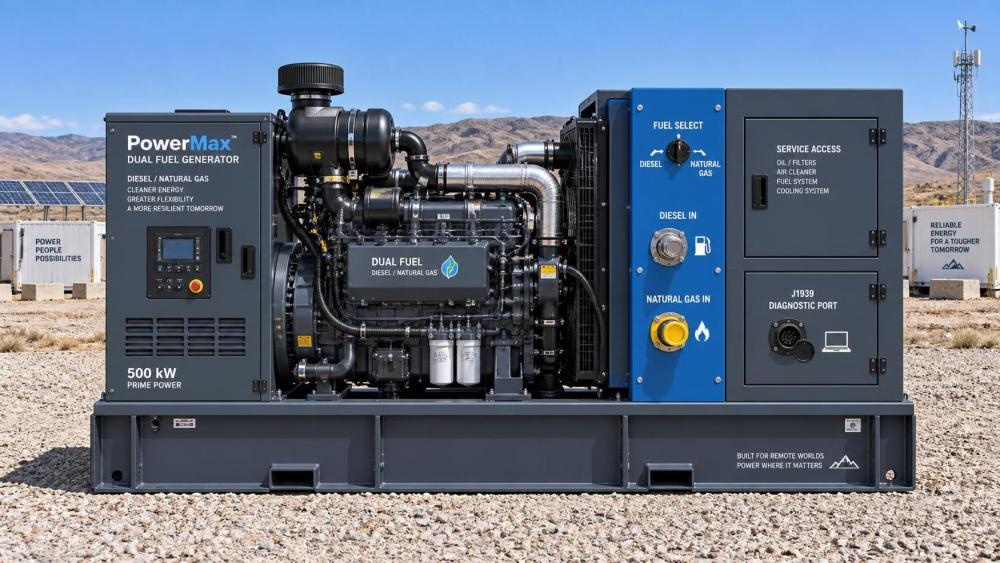
Remote and off-grid power projects rarely operate under textbook conditions. A generator set installed in a desert mining camp, an Arctic research station, or a jungle-based telecom repeater site faces fuel logistics that shift with season, regulation, and infrastructure access. Diesel may be the default assumption—but supply chains break. Biodiesel blends degrade in heat. Natural gas requires compression or pipeline proximity. Liquefied petroleum gas (LPG) demands robust vaporization in sub-zero ambient temperatures. What matters isn’t whether a unit *can* run on multiple fuels, but whether it maintains stable voltage and frequency across real-world transitions: cold starts at −30°C, load steps during refueling interruptions, or sustained operation on 15% bio-content diesel without injector coking or governor drift.
Manufacturers often list “dual-fuel” or “multi-fuel” capability in datasheets. But those claims rarely disclose derating curves, maintenance interval adjustments, or emissions compliance thresholds under mixed-fuel operation. For example, some engines require hardware swaps—different injectors, turbochargers, or ECU calibration files—to switch between diesel and natural gas. Others allow seamless blending but impose runtime limits above 20% biocomponent content unless oil analysis is performed every 125 hours. These aren’t fine print footnotes—they’re operational constraints that affect crew planning, spare parts stocking, and long-term reliability.
Maintenance Access Must Be Designed Into the Unit—Not Added After Installation
In remote settings, downtime isn’t measured in hours—it’s measured in lost production days, delayed commissioning, or compromised safety monitoring. A generator that nominally meets ISO 8528-1 performance standards means little if technicians cannot reach the oil filter without removing the radiator, or if the alternator bearing replacement requires engine removal from the skid. Field serviceability isn’t about convenience; it’s about minimizing mean time to repair (MTTR) when no workshop is within 500 km.
Key design indicators include: standardized fastener types (no proprietary torque bits), service intervals aligned with common lubricant shelf life (not just engine hours), and diagnostic ports accessible without disassembly. Some OEMs embed J1939 CAN bus diagnostics directly into control panels—enabling remote fault isolation before dispatching personnel. Others rely on proprietary software requiring laptop connection and firmware-level permissions, adding delay and dependency. For project managers, reviewing service manuals—not just spec sheets—is non-negotiable. If the manual lists “OEM-certified technician only” for tasks as routine as air filter replacement, that signals both training risk and extended outage windows.
OEM Support Readiness Means Localized Response, Not Just Global Brand Recognition
A well-known OEM name provides comfort—but does not guarantee support. In off-grid applications, response time depends less on corporate headquarters’ location and more on regional parts depots, certified field engineers, and documented escalation paths. A Tier 1 manufacturer may have strong presence in Europe and North America but no authorized service partner within 1,200 km of a West African gold site. Conversely, a mid-sized OEM with dedicated regional hubs in Southeast Asia or Latin America may offer 48-hour parts delivery and on-site calibration within five business days—even if its global brand visibility is lower.
What separates functional support from marketing claims? Documented SLAs covering parts lead time, technician availability, and firmware update validation—not just warranty duration. Also critical: whether the OEM publishes technical bulletins for known issues in specific ambient ranges (e.g., condensation management in high-humidity coastal installations) and whether those updates are backward-compatible with existing control systems. Projects using legacy controllers face compounding risk—if a 2021 firmware patch resolves harmonic distortion under variable-load solar hybrid operation, but requires controller hardware replacement, budget and timeline assumptions collapse.
Load Matching and Runtime Evaluation Reveal True Operating Cost
Initial purchase price accounts for less than 20% of total cost of ownership over a 10-year remote deployment. Fuel consumption dominates—but not uniformly. An industrial generator set operating at 35% load for 16 hours daily incurs significantly higher specific fuel consumption (g/kWh) than one running at 75% load for 8 hours—even if both meet the same ISO 8528 efficiency rating at 100% load. That’s because engine efficiency curves peak near 70–85% load and fall sharply below 40%. Ignoring this leads to oversized units that burn more fuel per kWh while accelerating wear on pistons, rings, and bearings due to incomplete combustion and carbon buildup.
Runtime evaluation must also account for parasitic loads: cooling fans, battery chargers, control system heaters, and auxiliary pumps. In sub-zero environments, heater loads alone can add 3–5 kW continuous draw—enough to push a 250 kVA unit into inefficient low-load operation during light-demand periods. Load profiling tools that log real-time kW, kVAR, and harmonic distortion over 7–14 days—not just peak demand estimates—provide the basis for accurate sizing. Oversizing by 30% “for future expansion” is rarely justified in off-grid contexts where fuel transport costs exceed $1.20/L and storage volume is constrained.
Procurement Decisions Should Anchor on Verifiable Service Evidence
When evaluating suppliers, request evidence—not promises. Ask for: (1) copies of service manuals showing torque specs, fluid capacities, and access diagrams; (2) regional parts availability reports with average lead times for top-10 consumables; (3) records of firmware updates applied to units deployed in similar ambient and fuel conditions; and (4) third-party verification of load bank test reports conducted at full load, 50% load, and transient step response—not just factory acceptance tests at rated output.
Also verify integration readiness. Many remote microgrids combine generators with solar PV, battery storage, and energy management systems (EMS). Does the generator’s controller support Modbus TCP, IEC 61850, or DNP3 natively—or does it require gateway hardware with undocumented latency? Does the OEM provide documented interface logic for black-start sequencing or island-mode transition? These aren’t engineering niceties. They define whether a 15-minute grid outage triggers a 45-minute manual reset or automatic re-synchronization.
Selecting an industrial generator set for remote use demands moving beyond catalog numbers and efficiency percentages. It requires matching fuel behavior to local logistics, designing maintenance into physical architecture—not workflow plans, and treating OEM support as a documented service contract—not a brand attribute. The most reliable units aren’t always the highest-rated; they’re the ones whose design decisions align with how, where, and for how long they’ll actually run.
Related News
- How to verify suppliers listed in a power system supplier directorySep 19, 2026Power system supplier directory verification guide: validate legal identity, technical compliance, factory quality, delivery capacity, references, and risk before selecting electrical equipment partners.
- What to verify before choosing an energy storage system supplierSep 17, 2026Energy storage system supplier checklist: verify system fit, certifications, safety, warranty, delivery capacity, and service support before committing to a contract.
- Can a Supplier Test Report Be Accepted Across Different Markets?Sep 17, 2026Can a supplier test report be accepted across different markets? Discover how standards, lab accreditation, product configuration, and local rules affect approval and market access.
- Selecting Industrial Generator Sets for Remote or Off-Grid Projects: Fuel Flexibility, Maintenance Access, and OEM Support ReadinessSep 18, 2026Discover how to select the right industrial generator set for remote projects—prioritizing fuel flexibility, field serviceability, and proven OEM support.
Related News
- 00
0000-00
How to verify suppliers listed in a power system supplier directory - 00
0000-00
What an intelligence portal for electronics industry should track - 00
0000-00
What to verify before choosing an energy storage system supplier - 00
0000-00
How electrical engineering for factories prevents costly downtime - 00
0000-00
When does a smart grid for buildings reduce peak demand charges?