
Yes, new industrial automation equipment can integrate with legacy systems, but compatibility is rarely a simple matter of connecting two devices. The practical question is whether the new equipment can exchange the right data, respond within the required time, and preserve the safety and availability of the existing operation.
A modern variable frequency drive, smart switchgear controller, PLC, condition-monitoring sensor, or supervisory platform may work alongside equipment installed decades ago. However, successful integration depends on more than protocol conversion. It requires a clear understanding of the legacy system’s control logic, electrical interfaces, communication limits, maintenance practices, and operational risks.
In power distribution, manufacturing, water treatment, transport infrastructure, and process industries, replacing every existing asset at once is usually unnecessary and often impractical. A phased modernization plan can extend the useful life of proven equipment while adding better visibility, control, energy management, and diagnostic capability.
Start With the Legacy System, Not the New Product
A common mistake is choosing new automation equipment because it has advanced features, then trying to force it into an older control environment. Integration should begin with an asset and interface review. Before selecting hardware, document what the current system actually does and how it does it.
This review should cover the field devices, controllers, panels, protection equipment, operator stations, software, cables, network segments, and manual procedures involved in the process. It should also identify the parts of the system that cannot tolerate interruption. A legacy motor starter panel may be simple electrically, for example, but it may feed a process where an unexpected stop has wider operational consequences.
Pay particular attention to the signals that matter. Older installations commonly use hardwired digital inputs and outputs, relay contacts, analog current or voltage signals, pulse signals, serial communications, or proprietary controller links. New equipment may support Ethernet-based industrial networks, web interfaces, modern data models, and remote diagnostics. These differences are manageable only when the required interface is defined precisely.
Questions to Answer Before Integration
- Which signals must be monitored, controlled, recorded, or alarmed?
- Does the existing equipment provide analog, digital, serial, or networked data?
- Which control functions must remain local if communication fails?
- What response time is required for commands, interlocks, trips, and alarms?
- Who owns the legacy controller logic, software files, passwords, and drawings?
- Can the existing electrical panel safely accommodate new sensors, gateways, power supplies, or communications hardware?
The answers separate a manageable retrofit from a project that needs a broader control-system redesign.
Compatibility Has Four Different Layers
When people ask whether modern automation can connect to legacy equipment, they often mean communication compatibility. That matters, but it is only one layer of the problem. A system can exchange data and still fail to operate correctly because its electrical, functional, or operational assumptions do not match.
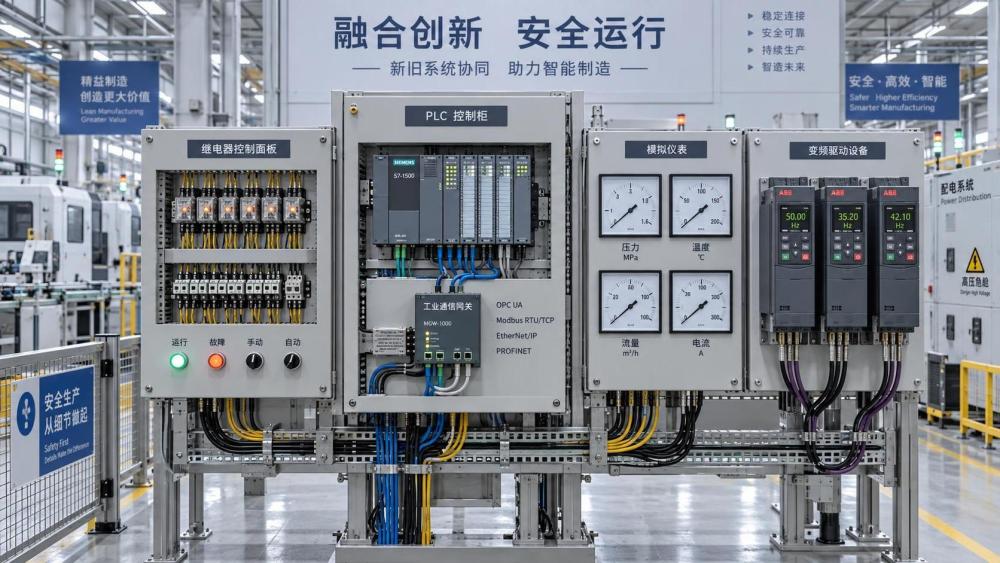
Functional compatibility deserves more attention than it usually receives. An integration gateway can translate a communication protocol, but it cannot automatically resolve ambiguous tag names, missing fault states, inconsistent time stamps, or undocumented relay logic. If the original system has evolved through years of field modifications, the drawings may not fully represent the current installation.
Choose the Least Disruptive Integration Architecture
There is no single best way to connect new industrial automation equipment to legacy systems. The appropriate approach depends on how much control is needed, how reliable the legacy data is, and how much operational disruption is acceptable.
Monitoring-only integration is often the lowest-risk starting point. New sensors, meters, or data acquisition equipment collect status, energy, vibration, temperature, or operating data without changing the existing control path. This is useful when the immediate goal is asset visibility, predictive maintenance, load analysis, or reporting. It also allows a team to validate signal quality before introducing any remote control capability.
Gateway-based integration is suitable when the legacy controller still performs reliably but needs to share information with a newer supervisory, energy management, or industrial data platform. A gateway can bridge serial and Ethernet networks or translate between different communication formats. It is a practical solution when replacing the original controller would create excessive downtime or require extensive rewiring.
Parallel control or supervisory control adds a new automation layer above the existing equipment. The legacy control system continues to execute local machine or feeder control, while the new platform coordinates sequencing, reporting, alarms, or higher-level optimization. This approach can work well in substations, pumping systems, conveyor lines, and multi-drive installations, provided control authority is clearly defined.
Full controller replacement becomes more appropriate when the legacy controller is unreliable, unsupported, undocumented, unable to meet safety requirements, or too limited for the required operating changes. Replacement may deliver a cleaner long-term architecture, but it carries more commissioning risk. It should not be treated as a routine hardware swap; the existing logic, interlocks, fault behavior, and manual operating modes must be reconstructed and tested.
Do Not Let a Communication Gateway Become a Hidden Single Point of Failure
Protocol converters and edge gateways are useful tools, but they should be placed carefully. If a gateway sits between a controller and an essential device, its failure can affect more than data visibility. The design should make a deliberate distinction between information flow and critical control flow.
For many retrofit projects, the safest arrangement is to keep protective functions, emergency stops, local interlocks, and time-sensitive equipment control independent of the new network layer. The new system can observe and coordinate, but it should not weaken the proven local safety path. This is especially important for switchgear, motor control centers, generator interfaces, and processes where an uncontrolled restart or delayed trip response would create significant risk.
Redundancy may be justified for communication paths that support essential operations, but redundancy alone does not solve poor system design. Operators also need understandable fallback behavior. When the network is unavailable, they should know whether the equipment remains locally controllable, holds its last command, enters a predefined state, or blocks remote actions.
Data Quality Is Often the Real Constraint
Legacy systems may have signals available, but availability does not guarantee that the information is useful. A digital status point can be wired incorrectly. An analog value can have an unclear engineering range. Event records may have inconsistent clock settings. An older controller may only expose a limited set of data points, leaving important conditions visible only on local indicators.
Before sending legacy data into a modern dashboard or digital twin, create a tag list that includes the source, signal type, units, normal operating range, alarm meaning, update expectation, and responsible owner. This may sound administrative, but it prevents misleading visualizations and unreliable automated decisions.
For example, a current reading from a motor feeder is more useful when it is linked to motor state, speed reference, fault status, and process condition. A value in isolation may suggest a problem where none exists. Likewise, an open/closed status for a breaker may not be enough for operational decisions if the system also needs trip indication, protection lockout state, spring charge status, or local/remote selection.
New industrial automation equipment can improve visibility, but it cannot recover information that the legacy system never measured. Where data gaps are critical, additional sensing may be more valuable than a more sophisticated software platform.
Plan the Transition Around Operating Windows
Integration projects are often delayed because the engineering focus is placed on equipment selection rather than cutover planning. In live industrial environments, the installation sequence matters as much as the final architecture.
- Survey and document the existing installation. Confirm wiring, panel space, grounding, controller versions, network routes, and actual field behavior before issuing final designs.
- Build and test the interface off-line where possible. Validate signal mapping, alarms, command logic, and gateway behavior before connecting to the live process.
- Install passive components first. New network infrastructure, power supplies, sensors, and monitoring equipment can often be added before any control changes are made.
- Commission one function at a time. Verify monitoring points, then alarms, then supervisory controls. Avoid introducing multiple untested changes during a short outage.
- Keep a rollback path. The original control method should remain available until the new arrangement has completed functional testing under normal and abnormal conditions.
Commissioning should include more than a normal start-stop test. Test loss of communication, loss of auxiliary power, incorrect sensor values, controller restart, local override, alarm acknowledgement, and restoration after an outage. These are the conditions that expose unclear control authority and hidden dependencies.
Cybersecurity Must Be Designed Into the Retrofit
Connecting a previously isolated controller or switchgear panel to a wider network changes its risk profile. Older automation equipment was often designed for closed environments and may not support modern security functions. Adding a network connection without segmentation can expose assets that were never intended to be reachable from business systems or remote users.
A practical approach is to separate operational technology networks from general office networks, limit communications to necessary paths, control remote access, and assign clear responsibility for account management and device configuration. Remote monitoring can be valuable, particularly across distributed power and industrial assets, but it should not create unrestricted access to control functions.
It is also important to account for maintenance. An integration solution that depends on an undocumented gateway configuration, a personal laptop, or an unsupported software license will become fragile over time. Record the network addresses, configuration backups, firmware dependencies, data mappings, and recovery steps as part of the project deliverables.
When Integration Is Not the Right Answer
Retrofitting is not always the most responsible choice. A legacy system may be too difficult to support when its control logic cannot be retrieved, spare parts are unavailable, faults are becoming frequent, or its safety behavior cannot be confidently verified. In those cases, adding gateways and overlays can postpone a necessary replacement while making the architecture harder to understand.
Full modernization is also worth considering when a facility needs major process changes, extensive new instrumentation, coordinated multi-axis motion control, or high-speed control functions that the existing platform was never designed to handle. The goal should not be to preserve old equipment at any cost. It should be to preserve what is reliable and economically useful while removing constraints that limit safe operation or future expansion.
Make the Investment Decision on Lifecycle Value
The cheapest interface is not always the lowest-cost solution over its operating life. A retrofit should be judged by the work it avoids, the risk it reduces, and the flexibility it creates. A small monitoring upgrade may be justified because it improves fault diagnosis and maintenance planning. A larger controller replacement may be justified because it removes a recurring support problem and enables future equipment additions.
The strongest projects define a clear boundary: what must remain stable today, what information is missing, what decisions need better data, and which future changes the architecture should accommodate. That boundary keeps the project from becoming either an unnecessary full replacement or a patchwork of temporary adapters.
For teams following changes in smart switchgear, industrial drives, power electronics, and digital-grid integration, GPEGM provides a useful intelligence perspective on how equipment trends connect with real power and automation infrastructure decisions. The relevant question is not whether new technology is more advanced in isolation, but whether it can improve the existing operating system without introducing a new weak point.
Frequently Asked Questions
Can a modern PLC communicate with an old machine controller?
Often, yes. The connection may require a serial interface, protocol gateway, hardwired signal exchange, or an intermediate I/O layer. The preferred method depends on whether the new PLC only needs machine status or must take part in active control.
Is it safer to start with monitoring rather than remote control?
Usually. Monitoring-only projects reveal data quality problems, wiring errors, and operator workflow issues without changing the existing control path. Remote control should be added only after control authority, interlocks, and failure behavior are fully defined.
Can old analog instruments be included in a digital automation system?
Yes, if their output signals can be read accurately through suitable input modules or signal conditioners. The conversion must preserve the measurement range, isolation requirements, and meaning of the original signal.
What should be documented before replacing a legacy controller?
Document the program logic, I/O list, panel wiring, interlocks, alarm behavior, manual modes, network settings, field device states, and recovery procedures. Capturing abnormal operating behavior is as important as documenting normal operation.
Related News
- What an intelligence portal for electronics industry should trackSep 18, 2026An intelligence portal for electronics industry tracks technology, demand, supply risks, standards, and competitors—turning complex signals into smarter decisions.
- How electrical engineering for factories prevents costly downtimeSep 16, 2026Electrical engineering for factories helps prevent costly downtime through selective protection, resilient control power, and smarter monitoring. Learn practical strategies now.
- Which inverter technology standards apply to grid-connected systems?Sep 14, 2026Inverter technology standards explained: explore safety, anti-islanding, grid codes, power quality, and certification checks for reliable grid-connected systems.
- What determines the required switchgear fault withstand rating?Sep 13, 2026Switchgear fault withstand rating explained: learn how fault current, clearing time, network configuration, and future expansion shape safe, cost-effective selection.
Related News
- 00
0000-00
How to verify suppliers listed in a power system supplier directory - 00
0000-00
What an intelligence portal for electronics industry should track - 00
0000-00
What to verify before choosing an energy storage system supplier - 00
0000-00
How electrical engineering for factories prevents costly downtime - 00
0000-00
When does a smart grid for buildings reduce peak demand charges?