
How do I verify inverter efficiency data for a tender? Start by treating the headline percentage as a claim to be checked, not a qualification result. A figure such as “maximum efficiency” tells you little unless you know which model was tested, how power was measured, and whether the operating conditions match your project.
For procurement teams, the difficulty is rarely finding efficiency figures. It is making competing figures comparable—and explaining the award decision when a bidder challenges it. Reliable verification requires a traceable link between the offered equipment, the test method, the measurement results, and the tender’s acceptance rule.
The following process applies across photovoltaic, battery-storage, and industrial-drive procurement, with important differences between these applications.
Define the efficiency you are actually buying
Before reviewing reports, establish the measurement boundary. Does your specification cover the inverter alone, the inverter with external filters and cooling equipment, or an entire conversion system? An apparently better result may simply exclude losses that another bidder includes.
For a DC-to-AC inverter, conversion efficiency is generally expressed as:
Efficiency (%) = measured AC active output power ÷ measured DC input power × 100
That equation is straightforward. Its application is not. Fans, control electronics, transformers, external cooling pumps, and auxiliary supplies may sit inside or outside the reported boundary. Require bidders to state how each is treated.
- PV inverters: Distinguish conversion efficiency from maximum power point tracking (MPPT) efficiency. Good conversion performance does not prove that the inverter consistently captures the available PV power.
- Battery inverters: Request charging and discharging efficiency separately. AC-to-AC round-trip system efficiency includes additional losses and must not be compared directly with one-way inverter efficiency.
- Industrial drives: Establish whether the figure describes the converter, a complete drive module, or a power drive system including the motor. Motor speed and torque affect the relevant operating points.
Also distinguish peak efficiency, achieved at a particular operating point, from weighted efficiency, calculated from several operating points using prescribed weights. Neither is automatically the right tender criterion. The appropriate measure depends on the equipment’s duty profile.
Build an evidence chain from the bid to the tested unit
A recognizable laboratory logo is not enough. The report must describe equipment that represents what will be delivered. Request the complete report, including annexes, rather than relying on a certificate summary or a cropped results page.
Model-family reports deserve particular care. A test on one power rating does not automatically establish the efficiency of every model sharing the same enclosure. Semiconductor selection, switching frequency, filter design, and cooling strategy may differ.
If a bidder submits family-level evidence, ask for the technical basis for its applicability. Accept it only where the tender permits that approach and the relationship to the offered model is adequately demonstrated.
Check that the standard answers the tender’s question
There is no single efficiency standard that covers every inverter application. Check the scope and edition of the cited document, not merely whether its designation looks familiar.
For photovoltaic equipment, IEC 61683 addresses efficiency measurement for photovoltaic power conditioners. EN 50530 addresses overall efficiency of grid-connected PV inverters and includes conversion and MPPT assessment. IEC 62891 addresses MPPT efficiency for grid-connected PV inverters. These references are relevant to different questions; citing an MPPT test alone does not establish a claimed conversion-efficiency result.
For industrial drives, IEC 61800-9-2 provides an energy-efficiency framework for power drive systems and related equipment. Its loss-based assessment and operating points should not be treated as interchangeable with PV weighted-efficiency ratings.
For storage applications, specify the applicable converter or system test method, power-flow direction, and measurement boundary explicitly. A battery-system performance result cannot establish inverter-only efficiency unless the report separately measures that boundary.
Safety certification and grid-connection compliance remain important, but they are not substitutes for efficiency testing. A compliant inverter may still lack evidence for the efficiency value stated in its bid.
Verify the laboratory’s relevant scope
ISO/IEC 17025 accreditation provides evidence of laboratory competence for activities within its accredited scope. It does not mean that every test a laboratory performs is accredited.
Check the laboratory’s current scope through the accreditation body, identify the relevant method or measurement capability, and establish whether the submitted results fall within that scope. Where procurement rules require recognized international arrangements, confirm that requirement too. Resolve discrepancies directly with the laboratory using independently obtained contact details.
A manufacturer’s internal test report can support technical review, especially during preliminary evaluation. Whether it satisfies final acceptance depends on the tender’s evidence requirements—not simply on whether the numbers appear credible.
Compare operating points, not brochure percentages
Imagine two bidders both claiming 98.5% efficiency. One measured at nominal DC voltage, moderate temperature, and unity power factor. The other reports a weighted value across several loads. The percentages look identical, but they describe different performance.
Build a comparison matrix using common conditions. Where the submitted reports do not align, seek supplementary data or require testing under a common procedure rather than adjusting results through unsupported assumptions.
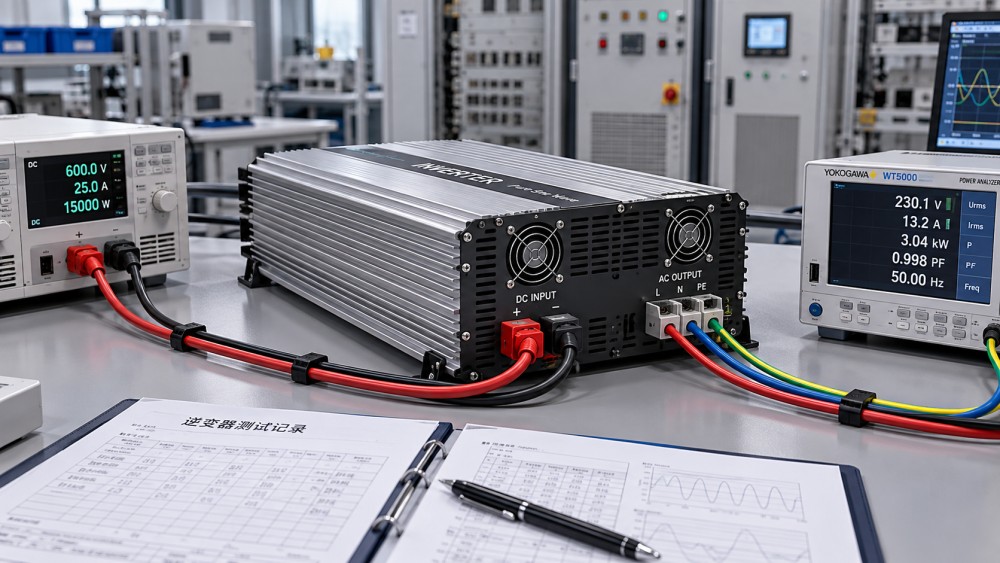
The most useful comparison points usually include:
- Load: Review part-load as well as rated-load performance. Equipment that spends long periods lightly loaded may gain little from an excellent full-load result.
- DC voltage: Request results across the project’s relevant input-voltage range. A peak value at one favorable voltage may not represent normal operation.
- Temperature: Check ambient conditions, thermal stabilization, cooling settings, and derating. A room-temperature test does not establish hot-site performance.
- Reactive power: Where voltage support is required, request efficiency or loss information at the specified power factors or reactive-power duties. Reactive current can increase losses without increasing useful active output.
- Direction of operation: For bidirectional equipment, compare charging with charging and discharging with discharging.
For weighted efficiency, request the underlying operating-point results and the weighting formula. European and California Energy Commission (CEC) weighted figures are not interchangeable. A project-specific weighting profile may be useful, but label it clearly and apply the same calculation to all bidders.
Do not estimate annual energy losses by applying peak efficiency to annual throughput. Use a representative operating profile and an appropriate efficiency map, with the assumptions documented.
Read the measurement details before accepting a narrow pass
High-efficiency equipment presents a measurement challenge: the losses are a small difference between two large power values. Small errors in input or output measurement can materially affect the reported efficiency.
Look for simultaneous input and output measurements under stable conditions, suitable power-analyzer and transducer accuracy, valid calibration records, and a measurement method appropriate for distorted waveforms. AC output must be measured as active power, not inferred from apparent power or nominal current.
The report should explain how measurement uncertainty was evaluated. A calibration certificate for the analyzer alone does not describe the uncertainty of the complete setup, which may also involve current sensors, wiring, range selection, and operating conditions.
Agree on the decision rule before results arrive
Suppose a tender requires efficiency of at least 98.0%, and a report gives 98.05% with expanded uncertainty of ±0.10 percentage points. The displayed value exceeds the threshold, but that does not by itself resolve conformity.
The outcome depends on the agreed decision rule. A simple acceptance rule may compare the measured value directly with the limit. A guard-band rule may require an additional margin to control false-acceptance risk.
For example, under a specifically agreed rule requiring the measured value minus expanded uncertainty to meet the limit, the lower value would be 97.95%, and the result would not pass. That subtraction is not a universal requirement; it illustrates why the rule must be stated in advance.
Record the uncertainty’s coverage factor and stated coverage probability where provided. Also distinguish percentage points from relative percentages, and avoid making a pass/fail decision from a rounded brochure figure.
Turn missing evidence into a controlled verification plan
Not every incomplete submission is false. Sometimes the bidder has supplied a marketing summary where the evaluator needs engineering evidence. Handle gaps through a documented clarification process consistent with the procurement rules.
- List the unresolved claims. Identify missing operating points, unclear auxiliary treatment, model mismatches, or absent uncertainty information.
- Request specific evidence. Ask for the relevant report pages, underlying readings, applicability statement, or laboratory confirmation—not merely a renewed declaration.
- Escalate material gaps. Where permitted, use an independent or witnessed test for claims that could change technical qualification or bid ranking.
- Record the disposition. Mark each criterion as verified, conditionally accepted, or not demonstrated, with supporting references.
For repeat testing, agree on the specimen, sampling approach, firmware, test points, stabilization criteria, instruments, uncertainty treatment, and acceptance rule before testing begins. Include the treatment of failed tests and repeat tests.
Witnessing adds transparency but does not replace a sound method or competent measurement. Likewise, factory acceptance testing on one selected unit does not establish production-wide consistency unless the contract includes an appropriate quality and sampling arrangement.
Put the verification requirements into the tender
Clear wording reduces disputes and prevents bidders from choosing whichever efficiency metric presents their equipment most favorably. Adapt the following requirement to the application:
The bidder shall submit efficiency evidence applicable to the exact offered model and configuration, identifying the test method and edition, equipment boundary, auxiliary-power treatment, operating conditions, measured input and output active power, and measurement uncertainty. Results shall cover the operating points specified in the tender. Laboratory competence and report applicability shall be demonstrated. Conformity shall be assessed using the decision rule stated in the tender.
Add application-specific schedules for load, voltage, temperature, power factor, and power-flow direction. Define whether weighted efficiency is mandatory, which weighting method applies, and whether particular operating points have minimum thresholds.
For the final evaluation, keep a compact audit trail linking every requirement to a report page, clarification, calculation, or witnessed-test record. Unsupported claims should remain visibly unverified rather than disappearing into an averaged technical score.
The defensible answer to “How do I verify inverter efficiency data for a tender?” is therefore not “request a certificate.” It is to establish a consistent measurement boundary, authenticate applicable evidence, compare like-for-like conditions, and apply a declared acceptance rule. That process makes efficiency a procurement criterion you can defend—not just a persuasive number on a datasheet.
Related News
- How to size a containerized energy storage system for peak shavingNov 04, 2026Size a containerized energy storage system for peak shaving. Learn to assess load data, demand charges, battery capacity and costs for a reliable project.
- Can an electrical grid platform integrate with legacy SCADA systems?Nov 02, 2026Can an electrical grid platform for utilities integrate with legacy SCADA? Explore protocols, cybersecurity and pilot steps to reduce risk and protect reliability.
- Can an electrical grid intelligence dashboard detect outages?Nov 01, 2026Can an electrical grid intelligence dashboard detect outages? Explore the data, detection methods, and essential tests that reveal how reliably it identifies power interruptions.
- How to select a circuit breaker for switchgear based on fault currentOct 31, 2026Choose the right circuit breaker for switchgear by evaluating fault current, interrupting capacity and coordination. Explore the essential checks.
Related News
- 00
0000-00
How to assess a smart grid device manufacturer's interoperability - 00
0000-00
How to size a containerized energy storage system for peak shaving - 00
0000-00
How to use a global power matrix for procurement negotiations - 00
0000-00
Can an electrical grid platform integrate with legacy SCADA systems? - 00
0000-00
Can an electrical grid intelligence dashboard detect outages?