
Which electrical standards apply to industrial equipment exports? The answer depends on the destination, the equipment’s function, and how it will be installed. A machine shipped to the European Union may need CE conformity assessment under applicable legislation. Equipment going to North America may need certification acceptable to the local electrical authority, alongside compliance with installation rules and machinery requirements.
Start by separating three questions: which laws apply, which technical standards support compliance, and who must accept the finished equipment. Treating these as one question often leads to the wrong certification scope—or a compliant control panel inside a machine that still cannot be accepted at its destination.
Identify what you are exporting before selecting standards
“Industrial equipment” is too broad to define a compliance route. A standalone motor, a variable-frequency drive, a low-voltage switchboard, and a complete production machine have different functions and assessment boundaries. Even when they share components, their requirements are not interchangeable.
Write a short equipment description covering:
- Supply boundary: A component, control panel, complete machine, assembly, or system supplied in separate sections.
- Electrical characteristics: Supply voltage, frequency, phases, load, earthing arrangement, and expected fault conditions.
- Intended use: The process, operating modes, users, and foreseeable maintenance activities.
- Installation environment: Indoor or outdoor use, moisture, dust, temperature, altitude, corrosion, and any explosive atmosphere.
- Destination: Country, installation location, customer specifications, and responsible approval authority.
This description determines what needs assessment. A drive installed inside a machine needs suitable component documentation, but its compliance does not establish the safety or electromagnetic compatibility of the complete machine. The manufacturer must also address integration, including protection, wiring, cooling, and control behavior.
Separate legal obligations, standards, and certification
Legislation establishes the legal obligations. It determines which products are covered, who carries responsibility, and what conformity procedures or documentation are required.
Technical standards describe requirements and assessment methods. IEC standards provide an international foundation for many electrical products. Regional and national standards may adopt that foundation with modifications. An IEC test report can support market access, but it does not automatically satisfy every destination’s requirements.
Certification provides evidence within a defined scope. A certification mark may cover a component, a panel, or a complete product. Its value depends on whether the receiving market recognizes the scheme and whether the certificate covers the equipment actually supplied.
Installation rules add another layer. They govern how equipment connects to the facility, including supply conductors, protection, grounding, and installation conditions. Passing a product assessment does not resolve every site requirement.
How requirements differ across major export markets
European Union: CE marking requires a complete conformity assessment
CE marking is the manufacturer’s declaration that the product meets all applicable EU requirements. It is not a universal certificate purchased from a laboratory. Some assessment routes allow manufacturer-led assessment; others require involvement from a designated conformity assessment body.
For industrial machinery, the applicable machinery framework addresses the machine’s risks, including electrical hazards. Electromagnetic compatibility requirements commonly apply as well. Other legislation can become relevant when equipment includes radio functions, pressure systems, or equipment intended for explosive atmospheres.
The relationship between machinery requirements and electrical safety legislation needs careful classification. Do not automatically list every electrical directive on a declaration simply because the machine uses electricity.
European standards adopted from IEC publications can provide a practical design route. Where a harmonized standard is cited under relevant legislation, applying its covered provisions can provide a presumption of conformity for the corresponding requirements. The standard’s scope, edition, and coverage therefore matter.
United States: establish the acceptance route with the installation authority
For US projects, distinguish the product standard from the installation code and the machinery electrical requirements. UL standards address many product categories. NFPA 79 addresses electrical equipment of industrial machinery, while the National Electrical Code addresses electrical installations where adopted.
A UL 508A industrial control panel certification covers the panel within its defined scope. It does not automatically certify the entire machine, its mechanical hazards, or every externally connected load.
Depending on the equipment and applicable rules, acceptance may involve certification by a Nationally Recognized Testing Laboratory, another accepted approval arrangement, or a field evaluation. Resolve the route with the customer and authority having jurisdiction before manufacture. Field evaluation can be useful for eligible equipment, but necessary modifications become harder once the machine is installed.
Canada and other markets: avoid assuming approvals transfer
US acceptance does not automatically establish Canadian acceptance. Equipment for Canada needs an approval route covering applicable Canadian requirements and acceptance in the installation jurisdiction. A certification mark covering both countries can simplify supply, provided its scope matches the product.
Elsewhere, IEC-based design may provide a strong starting point, while local rules still determine market entry. Depending on the product category, these can include national certification, importer obligations, labeling, or registration. Build the destination review around the exact product category rather than assuming that every electrical item follows the same scheme.
Match the standards to the equipment’s function
The following standards families are common starting points. They help define the technical investigation; they do not replace product classification or destination-specific assessment.
Use the relevant part of each standards family. A general reference to “IEC compliant” says little unless it identifies the assessed product, applicable requirements, and supporting evidence.
Equipment that depends on safety-related controls may also need assessment under standards such as ISO 13849-1 or IEC 62061. Selecting safety-rated devices alone does not validate the complete safety function. Its design, integration, and verification must support the required risk reduction.
Explosive atmospheres require a separate assessment path. An ordinary industrial enclosure or general-purpose motor approval does not establish suitability for combustible dust or flammable gas.
Resolve the design details that commonly block acceptance
Supply compatibility extends beyond voltage. Frequency, earthing arrangements, available fault current, and protective-device coordination can affect component selection. A transformer may change voltage without resolving motor performance, fault protection, or grounding issues.
For North American control panels, the short-circuit current rating deserves early attention. The panel’s rating must suit the available fault current at its connection point under the applicable installation requirements. A breaker’s interrupting rating alone does not establish the rating of the whole panel.
Enclosure ratings also need careful interpretation. An IP code describes specified protection against access, solids, and water. North American enclosure Type ratings address their own defined conditions. A similar-looking water protection claim does not make the ratings interchangeable, particularly where corrosion or other environmental conditions matter.
Electromagnetic compatibility depends strongly on installation. Drive filters, cable routing, shielding, bonding, and motor cable arrangements can affect emissions and immunity. Component test reports remain useful, but the assembled equipment and its installation instructions need to support the intended configuration.
Energy efficiency requirements can create an additional market-access obligation for covered motors and other equipment. Electrical safety approval does not establish compliance with efficiency, registration, or labeling rules.
Build a compliance roadmap before releasing the design
A useful compliance matrix connects each requirement to evidence and an owner. Give each row a product or hazard, destination requirement, applicable standard and edition, assessment method, required document, and responsible party.
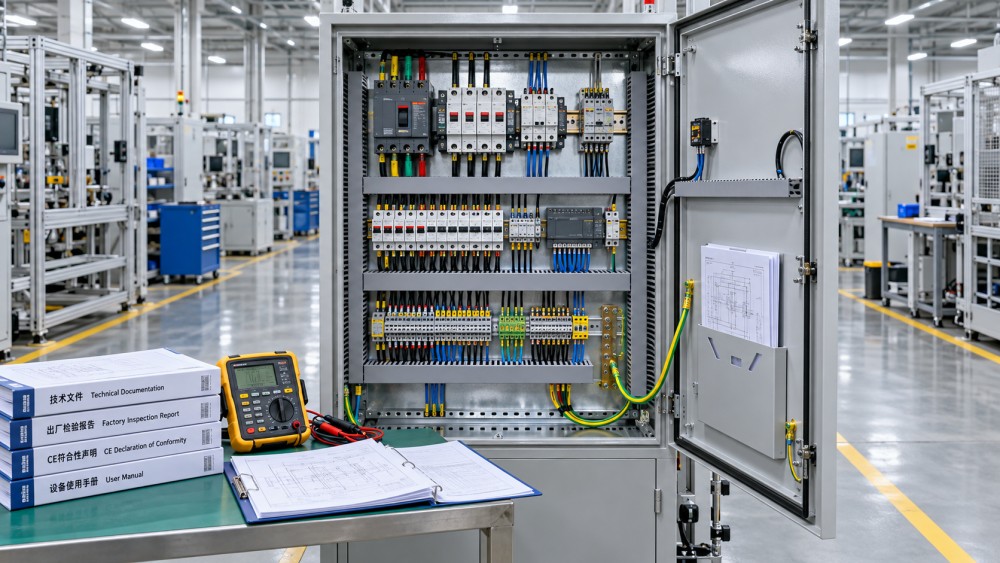
- Define the supplied product and installation boundary. Record what the exporter supplies and what the customer or installer must provide, including external protection and interconnections.
- Agree on the acceptance route. Identify the required certification, conformity declaration, site evaluation, or customer approval before purchasing critical components.
- Review the design against the selected requirements. Address electrical protection, bonding, thermal behavior, environmental exposure, safety controls, and electromagnetic compatibility.
- Collect evidence during construction. Maintain drawings, component records, calculations, inspection results, and test reports against the actual equipment configuration.
- Complete assessment and shipment documentation. Close findings, apply the appropriate markings, and issue the documents needed for market entry, installation, operation, and maintenance.
For configurable equipment, record which options the assessment covers. Changing a drive, enclosure, protective device, or cooling arrangement can affect previous conclusions. Component substitutions need engineering review even when the replacement has similar headline ratings.
Prepare documents that remain useful after delivery
The documentation package should allow an assessor or installer to understand what was built and under which conditions it can operate safely. It commonly includes electrical schematics, component identification, ratings, protective-device information, installation instructions, and relevant inspection or test records.
Keep the underlying technical file distinct from the customer’s operating manual. Detailed design evidence may be retained by the responsible manufacturer, while installers and operators need clear instructions covering connection, protective measures, operating limits, and maintenance. Supply documents and labels in the languages required for the destination.
Check that model numbers, ratings, drawings, and certification records describe the same configuration. A certificate for a related model offers little help when the delivered assembly differs in a way that affects its assessment.
Before approving the export build, obtain three concrete inputs: the destination’s acceptance route, the site’s electrical supply conditions, and the complete equipment configuration. Those inputs turn a vague request for “international compliance” into a design brief that engineering, purchasing, and the receiving site can use.
Related News
- How to size a containerized energy storage system for peak shavingNov 04, 2026Size a containerized energy storage system for peak shaving. Learn to assess load data, demand charges, battery capacity and costs for a reliable project.
- Can an electrical grid platform integrate with legacy SCADA systems?Nov 02, 2026Can an electrical grid platform for utilities integrate with legacy SCADA? Explore protocols, cybersecurity and pilot steps to reduce risk and protect reliability.
- Can an electrical grid intelligence dashboard detect outages?Nov 01, 2026Can an electrical grid intelligence dashboard detect outages? Explore the data, detection methods, and essential tests that reveal how reliably it identifies power interruptions.
- How to select a circuit breaker for switchgear based on fault currentOct 31, 2026Choose the right circuit breaker for switchgear by evaluating fault current, interrupting capacity and coordination. Explore the essential checks.
Related News
- 00
0000-00
How to assess a smart grid device manufacturer's interoperability - 00
0000-00
How to size a containerized energy storage system for peak shaving - 00
0000-00
How to use a global power matrix for procurement negotiations - 00
0000-00
Can an electrical grid platform integrate with legacy SCADA systems? - 00
0000-00
Can an electrical grid intelligence dashboard detect outages?