
Selecting power distribution equipment for Europe is not simply a matter of matching voltage, current, fault level, and price. The equipment must also fit the legal, safety, environmental, and grid-connection expectations of the country where it will be installed. A technically capable switchboard, transformer, circuit breaker, or monitoring system can still create approval delays, redesign work, or operating risk if its documentation and conformity route do not match the project.
For projects involving power distribution equipment in Europe, the most reliable approach is to treat compliance as a design input from the beginning. It should influence the specification of the enclosure, insulation system, protection functions, communications interface, materials, test evidence, and service documentation. Leaving these checks until procurement often leads to an apparently compliant product that is unsuitable for the actual installation environment.
European compliance is a selection framework, not one single certificate
European requirements are often discussed as if one mark or one declaration settles every issue. In practice, equipment selection involves several overlapping layers. Product rules establish essential requirements for safety, electromagnetic behavior, environmental restrictions, and market access. Harmonized European standards and national standards provide common technical methods for showing that equipment meets those requirements. Local grid operators, insurers, building authorities, and end users may add project-specific conditions.
This matters because a low-voltage distribution board used in a commercial building does not face exactly the same evaluation as a medium-voltage switchgear lineup for an industrial facility, a transformer connected to a renewable generation site, or a smart panel installed in critical infrastructure. The underlying question is not “Does this product have a certificate?” It is “Does the supplied configuration have evidence of conformity for this voltage level, application, installation arrangement, and intended operating environment?”
A product family certificate alone may not answer that question. Busbar ratings, short-circuit withstand capability, ingress protection, internal separation, installed protective devices, cable entry method, and software options can all change the final assembly. The documentation must correspond to the delivered equipment, rather than a more limited base version shown in a catalogue.
Start with the boundary between product compliance and installation compliance
A common procurement mistake is to ask the manufacturer to “make it European compliant” without defining what the installation requires. Product conformity and site compliance are related, but they are not interchangeable.
Product compliance concerns the equipment supplied: its construction, materials, protection against electric shock, temperature performance, electromagnetic compatibility, markings, instructions, and declared operating limits. Installation compliance concerns the complete electrical system: earthing arrangement, selectivity, upstream fault level, cable installation, fire strategy, accessibility, utility interface, room ventilation, and local construction rules.
For example, a metal-enclosed switchboard may be suitable as a product, yet become unsuitable when the installation has a higher prospective short-circuit current than the board was specified to withstand. A transformer may meet the relevant product requirements but require a different fire arrangement, oil containment approach, or acoustic treatment once placed inside a building. A monitoring gateway can meet electromagnetic requirements but fail to integrate with the required cybersecurity architecture or utility communication protocol.
Before comparing suppliers, define the installation boundary in writing. It should include the supply network characteristics, earthing system, ambient conditions, location, accessibility, maintenance philosophy, expected load profile, generation sources, and required interfaces with building management or grid systems. This information gives manufacturers enough context to offer a valid configuration instead of a generic quote.
Standards affect equipment choices long before factory testing
European technical standards do not merely influence the final label on the enclosure. They shape practical choices throughout the design. A specification for an assembly, for instance, may need to address rated operational voltage, insulation coordination, current-carrying capacity, short-circuit performance, temperature rise, degree of protection, mechanical resistance, and verification responsibilities.
The most important discipline is to identify the standard family that applies to the equipment category and then determine whether the supplied product has been verified as a complete assembly. This is especially important for modular low-voltage assemblies. Combining certified individual components does not automatically demonstrate that the complete board will manage heat, fault forces, clearances, protective continuity, and wiring arrangements as intended.
For medium-voltage equipment, the selection usually becomes more dependent on insulation medium, internal arc considerations, operating continuity, switching duty, interlocking, and the safety of maintenance activities. A specification based only on nominal voltage and rated current is incomplete. The fault rating, protection concept, room layout, access restrictions, arc-flash mitigation strategy, and operating procedure should be considered together.
For transformers, technical evaluation should extend beyond rated power and transformation ratio. Loss performance, cooling method, insulation class, environmental conditions, fire risk, noise sensitivity, overload profile, connection arrangement, and compatibility with harmonics can materially affect suitability. Efficiency-related requirements can also influence the choice between transformer designs, particularly where long operating hours make lifecycle losses more significant than the initial purchase difference.
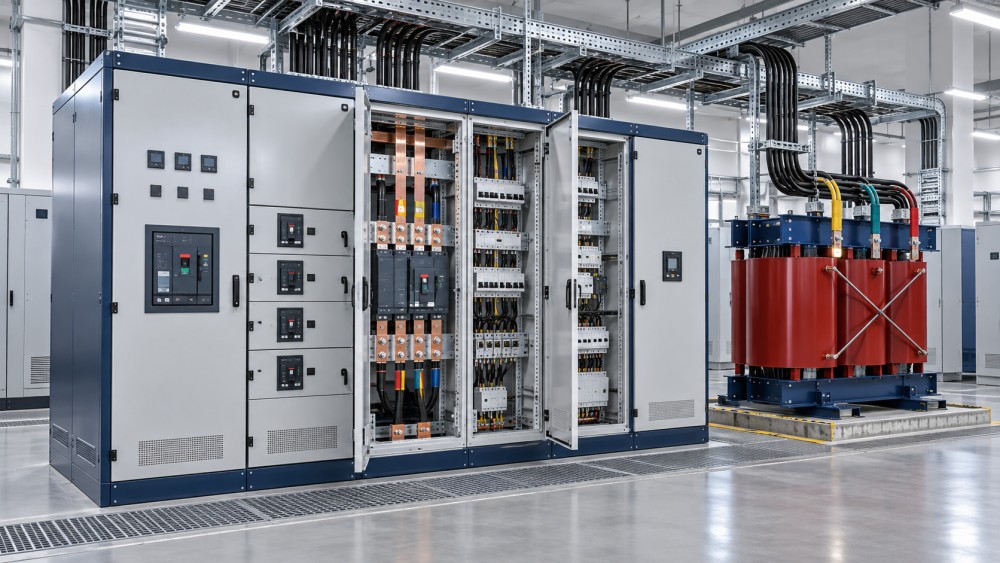
The equipment file should prove the delivered configuration
Documentation is often treated as an administrative handover item. In European projects, it is part of the technical evidence needed to make sound acceptance decisions. A useful documentation package should make it possible to trace the installed equipment back to the declared design and tested arrangement.
At a minimum, the file should clearly identify the manufacturer, product type, ratings, applicable conformity declarations, drawings, connection information, protective-device settings where relevant, installation instructions, operating limits, maintenance requirements, and warnings. Where a system is assembled or modified for a project, the responsibilities for the final assembly should be unambiguous.
Test evidence deserves careful reading. A factory routine test confirms that the delivered unit has undergone specified checks before dispatch. It does not replace design verification, type testing, or other evidence required for the performance claims being made. Conversely, a general test report for a similar product may not demonstrate compliance for the exact enclosure size, busbar arrangement, or protective-device combination supplied.
Ask suppliers to map each material requirement in the specification to a specific document. This is more effective than requesting “all certificates.” It exposes gaps early: a missing declaration for an installed electronic module, a short-circuit rating that applies only under conditions not present in the design, or an enclosure rating that changes once ventilation openings or cable glands are added.
Digital functions introduce a second compliance and reliability question
Smart switchgear, digital meters, protective relays, remote terminal units, and condition-monitoring devices can improve fault visibility and maintenance planning. They also expand the selection process beyond electrical ratings. Data communications, electromagnetic behavior, firmware management, user access, and interoperability become part of the equipment decision.
Remote monitoring is valuable when it serves a defined operating purpose. In a distributed portfolio, it may support centralized alarm handling and trend analysis. In a facility with variable loads or onsite generation, it can help identify overloads, reverse power conditions, harmonic issues, or abnormal temperature trends. It is less useful when data ownership, alarm responsibility, or maintenance response has not been defined. A dashboard does not reduce risk if nobody is accountable for acting on its alarms.
Specifications should identify the required protocol and integration point rather than simply asking for “smart” equipment. Consider whether the system must connect to an existing energy-management platform, a building-management system, a utility interface, or a secure industrial network. The required data points, update intervals, time synchronization, local control capability, and behavior during communications loss should be agreed before equipment selection.
Cybersecurity should be assessed as an operational property, not an optional software feature. A connected protection or monitoring device needs controlled access, sensible account management, secure update procedures, network segmentation, and a workable process for maintaining it over its service life. The most sophisticated communication option may be the wrong choice for a site without the capability to administer it.
Where selection decisions usually go wrong
The first error is choosing equipment based on a familiar rating label while ignoring the conditions behind it. A short-circuit rating, for example, can depend on protective-device coordination, installation orientation, enclosure arrangement, or stated duration. The rating must be evaluated against the actual fault conditions at the point of installation, not against an assumed system value.
The second is treating a country within Europe as technically identical to every other market in the region. Broad European conformity principles may apply, but grid connection rules, building practices, utility expectations, language requirements, and preferred standards can differ. This becomes visible at interface points: renewable generation connections, metering arrangements, protection settings, emergency supply systems, and public-network access.
The third is over-specifying a product because a larger rating appears safer. Oversizing can increase cost, footprint, losses, switching complexity, and maintenance burden without solving the real risk. The better choice is equipment with verified capability for the actual load profile, fault level, environmental conditions, and expansion plan. Reserve capacity should be intentional, not a substitute for system study.
The fourth is assuming that a component supplier has responsibility for the complete system. In a multi-vendor installation, responsibility for coordination can become unclear. Protective devices, busbars, enclosures, cables, transformers, and control systems may each be compliant individually while the assembled system has unresolved selectivity, thermal, communication, or earthing issues.
A practical evaluation sequence
A structured sequence avoids late-stage conformity problems and makes supplier comparisons more meaningful.
- Define the electrical duty. Establish system voltage, frequency, load behavior, prospective fault level, earthing arrangement, power quality conditions, and foreseeable operating modes such as generator operation or reverse power flow.
- Define the environment. Record indoor or outdoor location, temperature range, humidity, corrosion exposure, pollution level, altitude, seismic requirements where relevant, access restrictions, and fire strategy.
- Identify the applicable compliance route. Link the product category to the required European legal framework, relevant standards, and any local grid or project requirements.
- Specify complete-assembly performance. State required ratings and verification evidence for the final delivered configuration, rather than accepting claims for disconnected components.
- Review interfaces. Confirm protection coordination, transformer compatibility, cable terminations, control supply, communications, metering, monitoring, and required future expansion.
- Evaluate lifecycle practicality. Check spare-part availability, service access, labeling, maintenance intervals, software support, and the competence needed to operate the system safely.
Efficiency and environmental rules change lifecycle comparisons
European selection decisions increasingly require attention to energy losses and material restrictions, particularly for equipment that remains energized continuously. This does not mean the lowest-loss option is automatically correct. Loss performance must be considered with reliability, operating profile, cooling requirements, loading variation, expected service life, and the effect of harmonics or distributed generation.
For transformers, a lower-loss design can be attractive where the unit operates for long periods and energy costs dominate lifecycle expenditure. In a lightly loaded or intermittently used application, the balance between no-load losses, load losses, capital cost, and actual operating hours may lead to a different choice. For switchboards, attention should focus on thermal design, conductor sizing, ventilation, and the way future modifications could alter heat dissipation.
Material and environmental requirements also affect cable insulation, electronic modules, batteries, surface treatments, and disposal planning. These are rarely the headline procurement issues, but they can complicate replacement parts and documentation if ignored. Equipment with clear material declarations and controlled product-change processes is easier to maintain across a long asset life.
Make market intelligence part of technical evaluation
Standards compliance is necessary, but it does not remove commercial and supply-chain risk. Availability of copper and aluminum, component lead times, shifts in grid investment, and the rapid adoption of digital equipment can affect specification decisions. A design that relies on a narrow component set or difficult-to-service proprietary interface may be harder to sustain over time.
GPEGM tracks power equipment, distribution technology, and digital-grid developments in a way that can support this broader evaluation. The useful question is not simply which product is newest, but whether changes in efficiency design, semiconductor technology, smart switchgear architecture, or grid investment patterns affect the reliability, maintainability, and commercial resilience of the selected solution.
The strongest procurement decision combines verified conformity evidence with an installation-specific system review. That approach keeps European rules from becoming a late compliance exercise and turns them into a practical filter for selecting equipment that can be approved, installed, operated, and maintained with fewer avoidable compromises.
Related News
- How to assess utility protection and control system interoperabilityOct 16, 2026Assess protection and control systems for utilities with practical IEC 61850 checks, multivendor testing, and recovery criteria. Learn how to verify interoperability before deployment.
- How SCADA grid automation supports remote feeder fault isolationOct 14, 2026Discover how SCADA grid automation supports remote feeder fault isolation with verified switching, accurate topology, and clear stopping rules to help restore healthy sections reliably.
- How variable frequency drives cut energy use in water treatmentOct 11, 2026Variable frequency drives for water treatment cut pump and blower energy use with smart speed control—learn how to improve efficiency, reliability, and savings.
- How European rules affect power distribution equipment selectionOct 17, 2026Power distribution equipment Europe selection guide: understand compliance, standards, grid rules, digital requirements, and lifecycle factors for safer, approval-ready projects.
Related News
- 00
0000-00
How to vet power distribution technology suppliers for retrofits - 00
0000-00
How to estimate the payback period for green energy equipment - 00
0000-00
How to assess utility protection and control system interoperability - 00
0000-00
How energy prices affect the cost of decarbonizing industrial processes - 00
0000-00
How SCADA grid automation supports remote feeder fault isolation