
Selecting power distribution equipment for humid Southeast Asia
Selecting power distribution equipment Southeast Asia’s industrial facilities can rely on requires more than matching voltage and current ratings. Persistent humidity, condensation, coastal salt exposure, and high ambient temperatures can compromise insulation, accelerate corrosion, and shorten service life. The difficult part is that these stresses rarely act alone: a tightly sealed enclosure may exclude moisture-laden air but also retain heat.
A sound selection therefore starts with the installation environment, then checks enclosure protection, thermal performance, materials, and maintenance access together. A higher protection rating is not automatically a better specification. The equipment must remain electrically safe and serviceable under the conditions the site will actually experience, including shutdowns and loss of auxiliary power.
Define the environment before comparing quotations
“Tropical duty” is too vague to use as an acceptance criterion. A distribution board in a continuously conditioned electronics factory faces different risks from an outdoor feeder pillar beside a coastal loading area. Even within one facility, a switchroom above ground and a cable basement may need different moisture controls.
Record the expected temperature range, humidity variation, airborne contaminants, rain exposure, flood level, and room ventilation arrangements. Include operating states that are easy to overlook: weekend shutdowns, open loading doors, commissioning before air conditioning is available, and restarting a chilled room after humid air has entered.
Condensation occurs when a surface falls below the surrounding air’s dew point. Average relative humidity alone does not establish that risk. Temperature and humidity logging near the proposed equipment location is more useful than relying solely on regional weather averages. Where measurements are unavailable, document the assumptions and ask suppliers to identify the limits of their proposed design.
Also confirm the electrical duty: prospective short-circuit current, earthing arrangement, load profile, motor starting, harmonics, and any generator or photovoltaic connections. Environmental protection cannot compensate for inadequate fault withstand or unsuitable protection coordination.
An IP rating does not solve condensation
IEC 60529 classifies enclosure protection against access to hazardous parts, solid objects, and water ingress. It does not, by itself, demonstrate resistance to corrosion, internal condensation, or internal arcing. An IP-rated assembly can still contain humid air, particularly after installation or maintenance.
Select the rating against credible exposure rather than choosing the highest number available. Outdoor rain, wind-driven spray, cleaning practices, and dust each affect the decision. Then check the completed installation: cable glands, gland plates, ventilation openings, door seals, and field modifications must preserve the specified protection. A well-built cabinet with poorly sealed cable entries is still a vulnerable installation.
Anti-condensation heaters can keep internal surfaces above the dew point, but they need appropriate positioning, controls, and a dependable supply. Ask whether they remain energized when the main circuit is isolated. If moisture protection disappears during an extended shutdown, the design may fail precisely when the equipment is cooling and most exposed.
Filtered ventilation, closed-loop cooling, and room dehumidification each have a place. Ventilation does not necessarily dry a cabinet when incoming air is humid or salt-laden. Cooling equipment introduces condensate drainage and maintenance requirements; excessive cooling can also create cold surfaces. The preferred arrangement depends on both moisture balance and heat losses.
Check thermal performance in the offered configuration
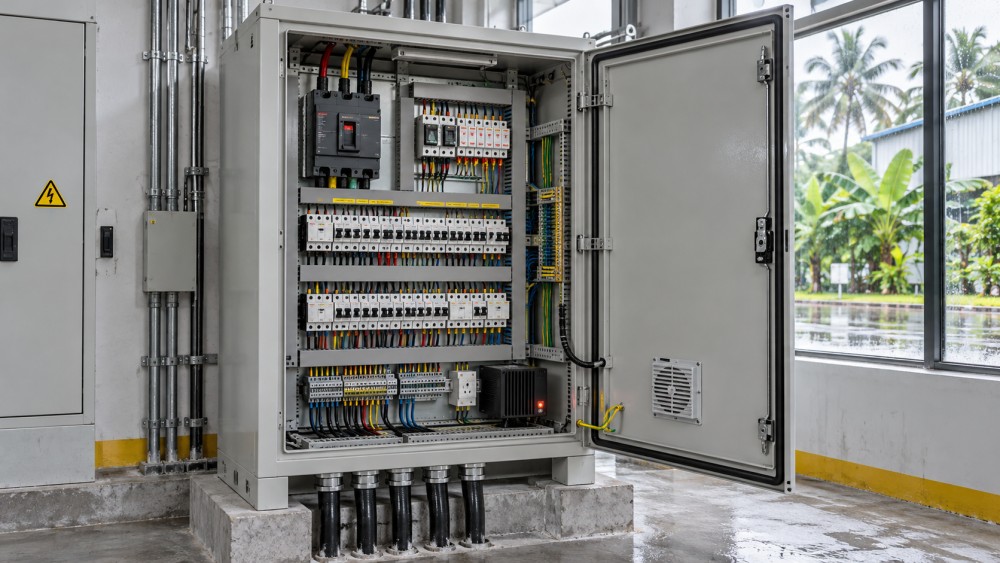
A common specification conflict is to request a compact, highly sealed assembly while retaining the current rating of a larger ventilated design. Breakers, busbars, joints, and electronic devices generate heat. Restricting heat rejection can require a larger enclosure, lower loading, or engineered cooling.
For low-voltage assemblies, IEC 61439-1 and the relevant product part, commonly IEC 61439-2 for power switchgear and controlgear assemblies, provide the applicable verification framework. Request temperature-rise verification evidence relevant to the offered configuration. A breaker’s catalogue current rating is not proof that the complete enclosed assembly can carry that current under project conditions.
Ask suppliers to state the ambient temperature basis, loading assumptions, enclosure arrangement, and any required derating. Outdoor equipment also needs consideration of solar exposure. Variable-speed drives and other nonlinear loads warrant a harmonic assessment rather than an automatic assumption that phase and neutral conductors experience conventional loading.
Cooling fans should not quietly become a hidden single point of failure. If the assembly depends on forced cooling, establish what happens when a fan stops or a filter blocks: alarm, load reduction, controlled shutdown, or another documented response. Compare that operating burden with the cost and space required for a passively cooled design.
Specify corrosion resistance beyond the cabinet shell
Near the coast, inspecting only the external enclosure material misses much of the risk. Hinges, fasteners, busbar supports, terminal hardware, exposed conductor surfaces, and earthing connections all deserve attention. Salt deposits combined with moisture can affect insulation surfaces as well as metalwork.
Stainless steel may be appropriate for some exposed locations, but the grade, surface finish, fabrication quality, and cleaning regime matter. Coated steel can also be suitable where its coating system matches the environment and damaged areas can be repaired. Neither option should be accepted on the strength of a material label alone.
Request details of coating preparation, edge treatment, dissimilar-metal interfaces, and replacement hardware. For aluminium conductors, verify compatible terminals and the manufacturer’s joint preparation and tightening instructions. For copper systems, ask how exposed connections are protected where contamination is expected.
Environmental test reports can help distinguish substantiated claims from “tropicalized” marketing. IEC 60068-2-30 addresses cyclic damp heat, IEC 60068-2-78 steady-state damp heat, and IEC 60068-2-52 cyclic salt mist. Their relevance depends on the specified severity, specimen, and acceptance criteria. A test on a coating sample does not establish the performance of an entire switchboard, and salt-mist exposure should not be translated directly into years of field life.
Separate electrical compliance from environmental suitability
Standards evidence should match the equipment category. Low-voltage assembly verification is different from component certification. For applicable medium-voltage metal-enclosed switchgear, IEC 62271-200 is relevant alongside the common specifications in IEC 62271-1. Check the editions required by the project, utility, and local authority rather than assuming one regional specification applies throughout Southeast Asia.
Pay particular attention to service-condition declarations. Compliance under normal conditions does not automatically establish suitability for persistent condensation or corrosive contamination. Any conditions outside the manufacturer’s declared limits need an agreed engineering response, not simply a note saying “suitable for tropical climate.”
Where internal arc classification is specified for medium-voltage equipment, examine the tested accessibility, accessible sides, current, duration, and installation arrangement. Pressure-relief paths and room geometry can affect whether the supplied configuration remains consistent with the tested design. An IP rating says nothing about this protection.
For protection devices and electronic trip units, confirm environmental limits separately. A cabinet may be structurally sound while an unprotected control power supply, relay, or communications module has a narrower humidity or temperature envelope.
Compare bids on evidence and operating consequences
A useful tender comparison makes suppliers expose their assumptions. Otherwise, the lowest-priced offer may simply omit the cooling, corrosion protection, or auxiliary supplies included by another bidder.
- Declared operating envelope: ambient limits, humidity conditions, condensation assumptions, contamination exposure, and required room conditions.
- Configuration-specific evidence: assembly verification, environmental test scope, and clear identification of anything not represented by the submitted evidence.
- Auxiliary dependencies: heater and cooling supplies, alarms, drainage, filter changes, and behavior after loss of power.
- Installation interfaces: approved cable-entry arrangements, plinth details, pressure relief where applicable, and responsibilities for sealing site-made openings.
- Service support: locally obtainable seals, fans, heaters, protective devices, and documented replacement procedures.
This is also where market intelligence needs to meet engineering judgment. The Global Power & Electrical Grid Matrix (GPEGM) connects developments in power equipment, distribution technology, and digital grids. Such intelligence can help frame choices around smart switchgear or changing material costs, but it cannot replace configuration-specific verification and local installation requirements.
Choose equipment the maintenance team can keep dependable
Humidity sensors and temperature monitoring can reveal deteriorating conditions, but only if somebody receives and acts on the alarms. Specify sensor locations, alarm responsibilities, and usable data access. A communications feature has little practical value if it cannot connect to the facility’s monitoring system or requires unsupported software.
Maintenance access deserves equal weight. Check whether seals can be replaced, drains inspected, filters serviced, and terminations examined safely. Inspection intervals should reflect contamination and operating experience rather than a generic annual schedule. Salt deposits or repeated condensation may justify closer attention, particularly after severe weather or prolonged shutdowns.
Before energization, use the manufacturer’s commissioning procedures to check cleanliness, moisture condition, protection settings, auxiliary operation, and installation integrity. Apply insulation tests only with appropriate isolation of sensitive electronics and other connected devices. Equipment that became wet during storage or construction needs assessment before switching on, not an assumption that operating heat will dry it safely.
The final selection should leave no ambiguity about three things: which environmental conditions the assembly can tolerate, what supporting systems it requires, and what the operator must maintain. If those answers are missing, a stronger enclosure or a more sophisticated monitoring package is not yet a complete solution.
Related News
- How to size a containerized energy storage system for peak shavingNov 04, 2026Size a containerized energy storage system for peak shaving. Learn to assess load data, demand charges, battery capacity and costs for a reliable project.
- Can an electrical grid platform integrate with legacy SCADA systems?Nov 02, 2026Can an electrical grid platform for utilities integrate with legacy SCADA? Explore protocols, cybersecurity and pilot steps to reduce risk and protect reliability.
- Can an electrical grid intelligence dashboard detect outages?Nov 01, 2026Can an electrical grid intelligence dashboard detect outages? Explore the data, detection methods, and essential tests that reveal how reliably it identifies power interruptions.
- How to select a circuit breaker for switchgear based on fault currentOct 31, 2026Choose the right circuit breaker for switchgear by evaluating fault current, interrupting capacity and coordination. Explore the essential checks.
Related News
- 00
0000-00
How to assess a smart grid device manufacturer's interoperability - 00
0000-00
How to size a containerized energy storage system for peak shaving - 00
0000-00
How to use a global power matrix for procurement negotiations - 00
0000-00
Can an electrical grid platform integrate with legacy SCADA systems? - 00
0000-00
Can an electrical grid intelligence dashboard detect outages?