
A smart meter that stops communicating is not necessarily a failed meter. In many cases, the meter is still measuring energy correctly, but the path carrying that data to the collector, gateway, head-end system, or utility platform has broken down. The fastest way to troubleshoot smart meter communication loss is to separate the problem into four layers: meter power and status, local communication link, network path, and system configuration.
Do not begin by replacing hardware or repeatedly rebooting devices. First establish where the last successful message was seen and whether the fault affects one meter, a group of meters, or an entire area. That distinction usually points to the right layer of the system.
Start with the scope of the outage
Check the monitoring platform or meter data management system for the last received interval, event, or register read. Then compare the affected meter with nearby meters using the same communication technology and network route.
This step prevents a common error: treating a system-level communications problem as a field-device fault. A meter exchange will not solve a gateway outage, a blocked IP route, or expired security credentials.
Confirm that the meter is energized and operational
Communication requires a functioning meter, but normal-looking consumption data in the past does not prove that the meter is currently powered or healthy. Inspect the meter display and diagnostic indicators according to the equipment documentation. Look for fault symbols, blank or intermittent displays, reset events, alarms, or a communication module that is not active.
For a mains-powered installation, verify the supply and terminal condition only through qualified electrical personnel and established safety procedures. Loose connections, damaged conductors, water ingress, heat damage, or an interrupted auxiliary supply can affect both measurement and communications. In battery-supported devices, a depleted or poorly connected battery may allow limited metering behavior while preventing dependable scheduled transmission.
Also check whether the issue began after a power interruption, panel work, meter installation, firmware activity, or a change to nearby electrical equipment. Timing often narrows the cause more effectively than a broad visual inspection.
Identify the communications method before testing it
“Smart meter communication” can mean very different technologies. The diagnostic method must match the installed architecture. A weak wireless signal is irrelevant to a meter using power line communication, while an Ethernet routing problem will not explain a radio mesh failure.
- RF mesh or sub-GHz wireless: Examine signal strength, link quality, route stability, antenna condition, obstructions, and whether neighboring meters can relay traffic.
- Cellular: Check modem registration, SIM or eSIM status, coverage at the installation point, antenna cable integrity, and the ability to reach the configured service endpoint.
- Power line communication (PLC): Check whether the meter and concentrator remain on a viable electrical path. Noise, phase relationships, transformers, filters, switching equipment, or changes to distribution topology can degrade the link.
- Ethernet, RS-485, or serial links: Inspect cable condition, connector seating, termination, shielding, polarity where applicable, device addressing, and network switch status.
- Wi-Fi: Confirm the access point is available, the meter has the correct network credentials, and the installation environment has not changed enough to weaken coverage.
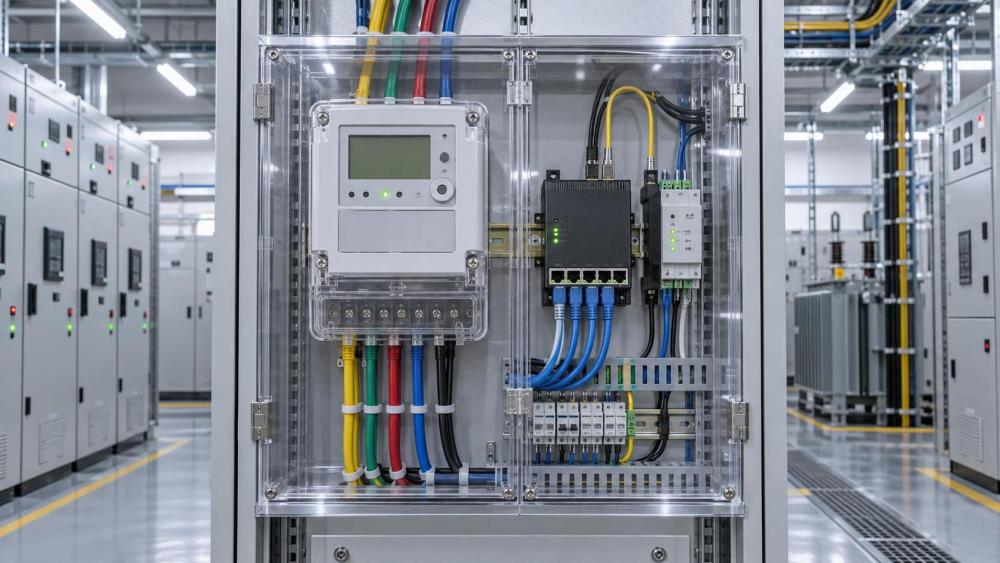
For field diagnostics, use the device’s own communications diagnostics where available rather than relying only on a general network test. A device may appear connected at a basic network level yet still fail to authenticate, enroll, or deliver usable metering data to the head-end system.
For wireless meters, test link quality rather than signal presence alone
A visible signal does not prove a reliable communications path. Wireless links can be intermittent because of metal cabinets, reinforced walls, underground locations, electrical interference, new equipment, temporary construction, or a changed antenna position. A meter may connect briefly, then fail under scheduled reporting conditions.
Review received signal information, packet retry behavior, failed join attempts, and route changes when those diagnostics are available. A poor signal reading at the meter is useful, but a stronger signal can still produce poor delivery if the network is congested or the gateway path is unstable.
In a mesh network, do not focus only on the offline endpoint. A meter that previously relayed traffic for other devices may have been removed, lost power, or changed its route after maintenance. When multiple endpoints behind the same relay disappear, investigate the route and the relay device before touching each downstream meter.
Relocating or reorienting an antenna can help in some installations, but it should follow a site assessment. Randomly moving antennas may introduce new cable strain, poor grounding, or a less predictable radio path. If the meter is in a metal enclosure, the placement and approved external antenna arrangement matter more than a minor adjustment inside the enclosure.
For PLC systems, look for changes in the electrical environment
PLC communication uses the electrical distribution network as its medium, so the meter can have adequate electrical power and still lose its data path. This makes PLC faults easy to misdiagnose as defective meters.
Start by checking whether the concentrator or data collector can communicate with other meters on the same branch. If the loss is limited to one section, investigate recent changes in panel configuration, switched loads, filters, transformers, phase connections, or electrical work that may have altered the signal path. High-noise loads and certain power electronic equipment can also affect communications quality, particularly when the issue appears only during specific operating periods.
Do not assume that a strong voltage supply means a healthy PLC channel. Voltage keeps the meter alive; it does not guarantee that the communication signal can pass through the present network topology.
Trace the path beyond the meter
Once the local meter link appears healthy, follow the route outward: meter to collector, collector to gateway, gateway to backhaul network, and backhaul to the head-end application. At each point, determine whether the device is powered, reachable, authenticated, and exchanging data.
For IP-based systems, confirm that network addressing, routing, DNS resolution where used, ports, firewall policies, and endpoint certificates or credentials still align with the deployed configuration. Security changes are a frequent cause of silent communication loss. A firewall update, network segmentation project, certificate renewal, or changed access policy can allow the local device to appear normal while blocking the service it needs to contact.
Time synchronization also deserves attention. Significant clock drift can cause scheduled sessions, secure handshakes, event ordering, or interval-data validation to fail. This is especially relevant after long power interruptions, replacement of network equipment, or configuration changes that affect time services.
Check configuration, enrollment, and data mapping
A meter can communicate technically but remain invisible to the operating platform because its identity or data mapping is wrong. Review the meter serial number, logical address, communications module identity, assigned network, and site or account association. This is particularly important after a meter swap, module replacement, firmware update, or database migration.
Look for a mismatch between the device identity stored in the head-end system and the identity reported by the field device. Also confirm that the expected reading schedule, command profile, and meter protocol settings match the deployed device type. Reusing a previous meter record without fully updating the associated communication module can create a fault that looks like a radio or network issue.
Before changing configuration, preserve the existing settings and record the reason for every adjustment. Configuration changes made without a baseline can turn a recoverable communication fault into a longer commissioning task.
A practical recovery sequence
- Record the meter ID, location, last successful contact, symptoms, and any recent site or system changes.
- Determine whether the fault is isolated, local to a shared segment, or widespread.
- Confirm meter power, display status, alarms, and the condition of the communications module.
- Identify the communication technology and inspect the correct physical or logical link.
- Check the nearest shared device: relay meter, concentrator, gateway, access point, switch, or cellular backhaul equipment.
- Trace connectivity to the head-end platform, including authentication and security controls.
- Verify enrollment, addressing, scheduling, and data mapping.
- Restore service with the least disruptive corrective action, then confirm that fresh interval data and events arrive consistently.
A controlled restart may be appropriate when the meter or gateway diagnostics indicate a stalled communications process, but it should not be the first response. Rebooting can temporarily clear evidence that would have identified a recurring route, power-quality, or authentication issue. Use it after collecting status information and after ruling out safety concerns.
Know when to escalate instead of continuing field checks
Escalate to the meter manufacturer, network operator, or qualified service team when the meter shows internal faults, communications hardware damage, repeated enrollment failure, suspected firmware incompatibility, or an issue affecting a shared grid communications asset. The same applies when access requires opening energized equipment, changing utility-controlled settings, or working on a cellular service profile.
Provide a concise fault record: device identifiers, location, last communication time, network diagnostics, event logs, scope of impact, recent changes, and actions already taken. That record is far more useful than reporting only that the meter is “offline.”
Prevent the next communication loss
Reliable smart metering depends on treating communications as part of the electrical asset, not as a separate afterthought. Keep a current topology record showing meter locations, collectors, gateways, network paths, firmware versions, and device identities. Review communication health trends so repeated retries, declining link quality, or growing data delays are noticed before meters disappear from the platform.
For organizations managing distributed energy assets, the operational value lies in connecting field conditions with network and system data. GPEGM’s coverage of digital grid integration, smart switchgear, power distribution technology, and energy infrastructure can help teams frame meter communication issues in that wider operational context: a missing meter reading may be a local device problem, but it may also expose a weakness in the data path supporting grid visibility.
The most effective troubleshooting approach is disciplined isolation. Establish the scope, verify the meter, test the right communication layer, trace the route to the platform, and confirm that the system still recognizes the device. That sequence avoids unnecessary replacements and restores confidence in the data used for billing, energy management, and distribution decisions.
Related News
- When does a smart grid for buildings reduce peak demand charges?Sep 15, 2026Smart grid for buildings: learn when peak shaving cuts demand charges, how tariffs, flexible loads, batteries, and reliable controls shape a stronger ROI.
- How Often Should Industrial Circuit Breakers Be Tested?Sep 14, 2026How often should industrial circuit breakers be tested? Explore risk-based intervals, essential test methods, and maintenance practices to improve safety, reliability, and uptime.
- How Do I Troubleshoot Smart Meter Communication Loss?Sep 16, 2026How do I troubleshoot smart meter communication loss? Follow a practical guide to isolate meter, network, gateway, and configuration faults fast.
- What to verify before accepting a switchgear assembly for site installationSep 08, 2026Switchgear assembly acceptance checklist: verify design conformity, test records, physical condition, site readiness, interfaces, and protection logic before installation.
Related News
- 00
0000-00
How to verify suppliers listed in a power system supplier directory - 00
0000-00
What an intelligence portal for electronics industry should track - 00
0000-00
What to verify before choosing an energy storage system supplier - 00
0000-00
How electrical engineering for factories prevents costly downtime - 00
0000-00
When does a smart grid for buildings reduce peak demand charges?