
Insulator contamination changes high voltage line maintenance because a line can lose insulation strength without a cracked disc or a visibly broken component. Salt, industrial emissions, agricultural dust, and other deposits can form a conductive surface layer when wetted. A string that performs adequately in dry weather may become vulnerable during fog, dew, mist, or light rain.
For maintenance teams, the practical response is to combine deposit severity, wetting conditions, and insulator condition when setting priorities. A fixed cleaning interval may remain useful for scheduling, but it cannot establish whether a particular string will withstand the next pollution event. The strongest maintenance decisions connect inspection findings with local weather, contamination sources, and evidence of electrical activity.
Why contamination becomes an electrical problem
Deposits affect insulation through their interaction with water. Soluble salts can dissolve into a conductive film, allowing leakage current to flow along the insulator surface. Insoluble material can retain moisture and influence how that film develops. Two strings carrying similar amounts of visible dust may therefore behave differently if the deposits have different chemical compositions or encounter different wetting conditions.
As surface current flows, heating can dry small areas of the wetted contamination layer. These dry bands interrupt the conductive path, concentrating voltage across relatively short distances. Discharges may bridge them. Under sufficiently unfavorable conditions, those discharges can extend across the insulation surface and develop into a flashover.
Flashover risk consequently does not rise in direct proportion to how dirty an insulator looks. A thin salt deposit can be more consequential than a thicker layer of less conductive material. The location of contamination also matters: sheltered undersides may accumulate deposits that rainfall does not remove effectively, while uneven wetting produces localized electrical stress.
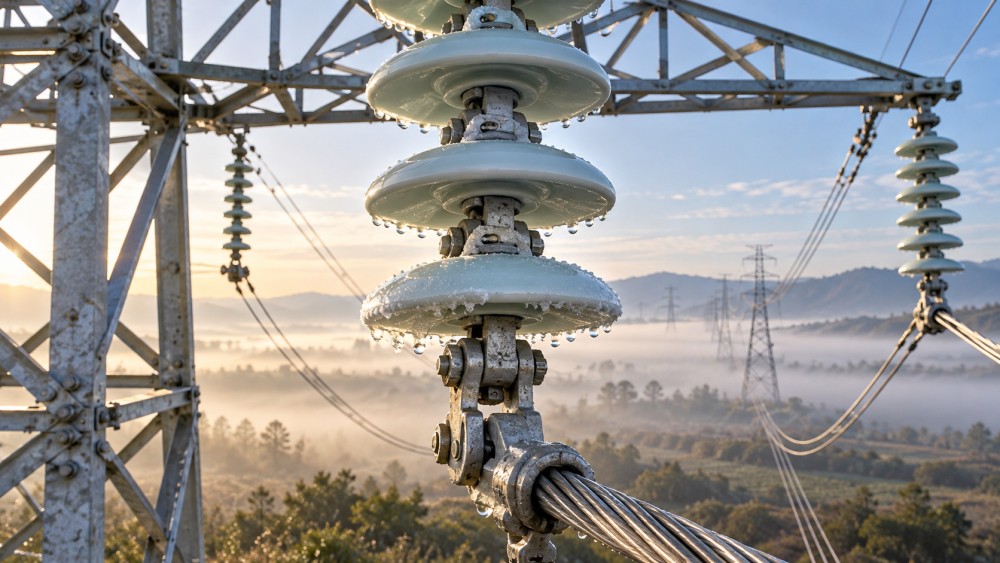
Weather can either relieve or activate the problem. Sustained rain may wash exposed surfaces, but the initial wetting stage can make deposits conductive before substantial cleaning occurs. Fog and dew can wet a surface without providing meaningful washing. Maintenance planning should therefore distinguish weather that removes contamination from weather that mainly activates it.
Material behavior adds another variable. Silicone rubber surfaces can resist the formation of continuous water films through their hydrophobic properties, and some silicone materials can transfer hydrophobicity into a deposited layer. That benefit depends on material condition, contamination, and exposure. Porcelain, glass, and polymer insulators should not be assigned identical maintenance thresholds simply because they operate at the same voltage.
What inspection must establish before a cleaning decision
A useful inspection answers three connected questions: what has accumulated, how it becomes wetted, and whether the insulation shows distress. Photographs provide a valuable record, but a visual cleanliness rating alone cannot answer all three.
Begin with the exposure pattern along the route. Coastal sections may experience wind-driven salt; industrial areas may receive deposits whose composition changes with nearby operations; agricultural or construction activity may produce seasonal dust. Towers close together can face different conditions because of elevation, prevailing wind, shelter, or distance from a source. Route-wide assumptions can conceal the spans most likely to need attention.
Inspection records should identify where deposits collect on the string, including sheltered surfaces, and distinguish removable contamination from physical deterioration. Cracked porcelain, damaged glass units, eroded polymer housings, tracking, exposed interfaces, and corrosion require their own assessment. Cleaning cannot restore lost material or repair a compromised seal.
Surface sampling can support a more defensible pollution assessment. Equivalent salt deposit density, or ESDD, expresses soluble contamination in terms of equivalent sodium chloride loading per unit area. Non-soluble deposit density, or NSDD, characterizes insoluble deposits. Together, these measurements help describe contamination that visual inspection may misjudge.
Neither measurement is a universal maintenance trigger. Results depend on sampling location, collection method, time since rainfall or washing, and the surfaces included. Comparisons become more useful when teams use consistent procedures and sample representative positions. A single sample collected after heavy rain may say little about the accumulation preceding a seasonal fog event.
Electrical observations provide another layer of evidence:
- Leakage-current monitoring can reveal changes in surface conduction and discharge activity, especially when records include humidity, rainfall, and temperature. Sensor placement and signal interpretation affect the usefulness of the result.
- Ultraviolet inspection can help locate discharge activity, but teams must distinguish contamination-related surface discharges from corona associated with hardware, geometry, or defects.
- Infrared inspection may reveal abnormal heating under suitable conditions. A normal thermal image does not establish that a contaminated string will remain reliable during a later wetting event.
Any increase in discharge activity should be interpreted against operating voltage, weather, material condition, and the string’s own history. A universal leakage-current alarm value applied across different insulator designs and environments can create false confidence or unnecessary interventions.
After-sales teams also need a disciplined handover between inspection and engineering. Reports should identify the asset, insulator type, affected surfaces, weather conditions, observed damage, and previous treatment. “Dirty insulator” is too broad a diagnosis to support a decision between washing, coating, and replacement.
Turning findings into cleaning and intervention priorities
Condition-based maintenance works best when it adjusts a planned program using evidence. Established cleaning cycles provide access, resources, and accountability; inspection and monitoring determine where those cycles need to move forward, extend, or change. Waiting for obvious arcing before acting can leave too little time to arrange an outage.
The highest priorities are locations where conductive deposits, likely wetting, and evidence of deteriorating performance coincide. Consequence also matters. A string on a circuit with limited operational flexibility may justify earlier intervention than a comparable string where an outage is easier to accommodate. That is a system planning decision as well as an insulation assessment.
Several field patterns warrant different responses:
- Accumulation before a recurring wet season: schedule inspection and, where justified, cleaning before the expected wetting period. Use local records to choose the timing.
- A sudden contamination event: reassess affected sections after unusual salt exposure, nearby construction, or a change in industrial emissions. The previous maintenance interval may no longer represent the exposure.
- Repeated discharge after cleaning: investigate remaining deposits, damage, wetting patterns, and insulation suitability. Simply shortening the washing interval may leave the underlying cause unresolved.
- Low visible contamination with wet-weather disturbances: examine soluble deposits and sheltered surfaces, while checking other possible causes of the disturbances.
Cleaning methods must match the insulator material, deposit, equipment arrangement, and working conditions. Water washing, manual cleaning, and other approved methods have different access requirements and limitations. Abrasive tools or unsuitable chemicals can damage polymer housings or protective coatings. Cleaning instructions should specify compatible materials and the required finish, supported by manufacturer guidance.
Energized washing requires a formally engineered and authorized procedure, qualified personnel, and equipment suited to the installation. Water quality, delivery conditions, approach distances, weather, and electrical configuration all affect safety. Generic instructions cannot establish safe operating parameters for a particular line. Where those requirements cannot be met, maintenance planning must provide an appropriate de-energized work arrangement.
After cleaning, verification should examine both the surface and the original symptom. Record any residual deposits, newly visible defects, and damage identified during access. Where monitoring is available, compare electrical behavior under reasonably comparable conditions. A lower leakage current on a dry afternoon provides limited evidence of performance during fog.
The interval until contamination returns is especially useful. If similar deposits reappear quickly, repeated cleaning may impose substantial access and outage demands. That recurrence supports an engineering review of surface treatment or insulation design, particularly where the pollution source is persistent.
When coatings or replacement become the stronger option
Cleaning removes accumulated contamination but does not alter the site’s exposure. Where wet-weather problems recur, teams should examine whether the installed insulation remains suitable for the environment. Relevant factors include creepage distance, shed profile, orientation, material behavior, and the way deposits accumulate on sheltered surfaces.
Longer creepage distance can improve pollution performance, but geometry determines how effectively that distance works. Closely spaced or deep sheds may retain deposits or experience unfavorable wetting under particular conditions. A replacement decision based only on a larger creepage figure can overlook these effects.
The IEC 60815 series provides a framework for selecting and dimensioning high-voltage insulators for polluted conditions. Its application requires attention to the relevant system and insulator type, including differences between AC and DC service. It supports an insulation suitability assessment; it does not supply a universal field-cleaning interval.
Laboratory evidence also needs careful interpretation. IEC 60507 addresses artificial pollution testing of high-voltage ceramic and glass insulators for AC systems. Such testing can support performance assessment within its scope, but a result obtained under a specified test condition does not directly predict a maintenance interval at every site. Deposit composition, natural wetting, installation geometry, and material behavior can differ from the test arrangement.
Room-temperature-vulcanizing silicone coatings can improve the surface behavior of suitable ceramic or glass insulation in polluted environments. Their effectiveness depends on surface preparation, product suitability, application quality, adhesion, and subsequent condition. A coating program therefore creates an inspection responsibility: teams must look for deterioration, loss of adhesion, and damage, and use compatible cleaning methods.
Coating is an unsuitable substitute for repairing a damaged unit or resolving a mechanically compromised assembly. Before treatment, confirm that the underlying insulation and hardware remain serviceable. Procurement specifications should address preparation, application controls, acceptance criteria, repair procedures, and maintenance compatibility, rather than relying solely on a product’s stated hydrophobicity.
Replacement deserves closer consideration when contamination-related distress persists despite suitable cleaning, when material damage is present, or when recurring access requirements make the existing arrangement difficult to maintain. Evaluate the complete assembly, including mechanical requirements, electrical clearances, fittings, and field-control components where applicable. A change in insulator technology needs an engineering review beyond its surface pollution characteristics.
The most useful maintenance record connects each intervention to the conditions it was intended to address. Record the contamination evidence, wetting exposure, observed electrical behavior, treatment, and subsequent recurrence. Over successive service cycles, that record gives the next crew a practical basis for deciding whether another wash is justified or whether the location needs a different insulation solution.
Related News
- How to inspect pole condition on 11 kV and 415 V overhead linesNov 02, 2026Improve 11kv/415 overhead transmission lines maintenance with practical pole inspection guidance. Spot decay, cracks and corrosion, prioritize risks, and plan safer action. Explore the guide.
- When should vegetation trigger high voltage power line maintenance?Oct 30, 2026When should vegetation trigger high voltage power line maintenance? Discover key warning signs, clearance risks, and proactive steps to prioritize work before outages occur.
- How insulator contamination shapes high voltage line maintenanceOct 29, 2026Improve high voltage line maintenance with insights on insulator contamination, flashover risks, and smarter cleaning strategies. Discover when to clean, coat, or replace.
- How drone inspections improve high voltage line maintenance planningOct 14, 2026High voltage line maintenance planning improves with drone inspections that reveal defects, access risks, and vegetation issues for safer, faster, risk-based repairs.
Related News
- 00
0000-00
How to assess a smart grid device manufacturer's interoperability - 00
0000-00
How to size a containerized energy storage system for peak shaving - 00
0000-00
How to use a global power matrix for procurement negotiations - 00
0000-00
Can an electrical grid platform integrate with legacy SCADA systems? - 00
0000-00
Can an electrical grid intelligence dashboard detect outages?