
For humid sites in Southeast Asia, the right power distribution equipment is rarely the unit with the highest nominal IP rating or the lowest purchase price. Reliable selection depends on whether the complete assembly can resist condensation, corrosion, water ingress, heat accumulation, and maintenance errors over its operating life.
A standard indoor panel can perform adequately in a conditioned electrical room. The same construction may fail prematurely in a coastal utility area, a semi-open plant room, a basement prone to flooding, or a construction site exposed to monsoon rain. The practical decision is therefore not simply “which switchboard?” but “what enclosure, internal components, installation arrangement, and verification evidence are appropriate for this exact exposure condition?”
Start with the site exposure, not the electrical single-line diagram
Voltage, prospective short-circuit current, load diversity, and protection coordination remain the foundation of distribution design. In Southeast Asian projects, however, environmental exposure must be treated as an equal design input. Humidity does not only affect external sheet metal. It can create condensation on busbars, terminals, relay boards, metering devices, insulation surfaces, and breaker mechanisms. Once moisture combines with airborne chlorides, sulfur compounds, dust, or process contaminants, the risk moves from cosmetic corrosion to insulation tracking, loose connections, false trips, and overheating.
The most useful early distinction is between four site conditions:
- Conditioned indoor rooms: Equipment is protected from direct weather, but condensation remains possible when air-conditioning is intermittent, doors are frequently opened, or the room temperature falls below the dew point.
- Unconditioned indoor rooms: Common in warehouses, plant utility buildings, and service areas. These locations need better corrosion resistance and thermal design than a conventional office-building electrical room.
- Covered but open-sided areas: Canopies protect against direct sun and some rain, but wind-driven water, high humidity, insects, and salt-laden air can still reach the equipment.
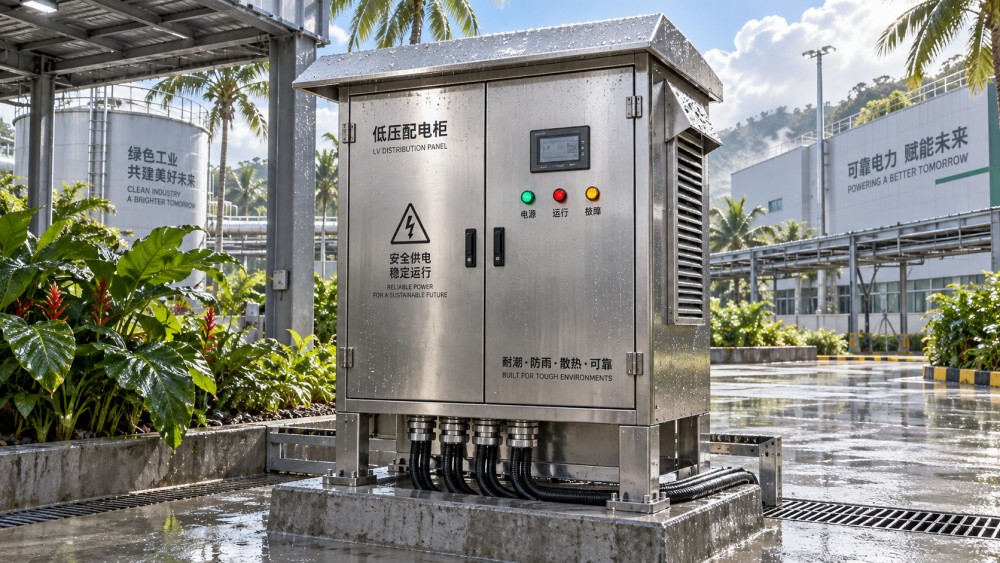
- Outdoor or coastal installations: These require a system-level approach to weather protection, drainage, UV exposure, corrosion category, cable entry, and service access. A nominal enclosure rating alone is not enough.
“Tropicalized” should not be accepted as a complete technical requirement. It is a broad commercial description, not a substitute for defined enclosure protection, material specification, corrosion protection, temperature limits, and environmental test evidence.
Humidity damage is often caused by condensation, not direct rain
Direct rain is visible and usually considered during design. Condensation is less obvious and often more damaging. It occurs when the temperature of an enclosure surface or internal component falls below the dew point of humid air. This can happen overnight, during rainstorms, after an air-conditioning shutdown, or when a lightly loaded panel cools rapidly.
A fully sealed enclosure does not automatically solve this problem. If moist air enters during installation, maintenance, or through imperfect cable glands, it can be trapped inside. Daily temperature cycling may then produce internal moisture even though the enclosure has no obvious leak. High internal heat can also shorten the life of electronic meters, communication modules, surge protective devices, variable-speed drive interfaces, and protective relays.
For non-conditioned and outdoor cabinets, the specification should establish how condensation will be managed. Depending on the installation, this may include anti-condensation heaters with thermostatic or hygrostatic control, a correctly sized breather-drain arrangement where the enclosure design permits it, internal separation from cold external walls, and cable entry arrangements that do not channel water into the cabinet.
Heaters should not be treated as an automatic accessory. They consume auxiliary power, require wiring and control verification, and can create local hot spots if poorly positioned. Their purpose is to maintain internal conditions above the condensation threshold, not to compensate for inadequate enclosure design or water entry.
Choose the enclosure rating according to the real water path
Ingress protection under IEC 60529 is important, but the IP code must match the likely exposure. An indoor panel in a dry electrical room does not need the same enclosure performance as equipment subject to wind-driven rain or washdown. Equally, specifying a very high IP rating everywhere can create problems if heat rejection, access, gland design, and maintainability are ignored.
For project evaluation, ask where water will actually come from:
- Rain striking doors, roof joints, and side panels;
- Wind-driven spray entering louvers or poorly protected vents;
- Water running down incoming cables and passing through glands;
- Floodwater or surface runoff entering through the cabinet base;
- Condensation forming internally;
- Cleaning water in food, pharmaceutical, transport, or process facilities.
The enclosure rating applies to the tested assembly configuration. A cabinet may have an appropriate rating before field modifications, then lose it after installers drill new entries, use unsealed knockout holes, fit incompatible glands, or leave unused openings unblanked. Cable entry is therefore part of the equipment selection, not a site detail to be resolved later.
Outdoor switchboards benefit from features that are more consequential than a headline IP number: sloped rain sheds, external sunshades where needed, protected ventilation paths, raised plinths, sealed bottom-entry zones, drainage provisions, and door arrangements that limit exposure during maintenance. In flood-prone locations, mounting height and room drainage can matter more than upgrading an enclosure from one IP class to another.
Corrosion resistance must cover the whole assembly
Coastal zones, ports, wastewater facilities, chemical plants, and some industrial corridors present a different threat from humidity alone. Chloride-bearing air can attack painted steel, fasteners, hinges, gland plates, copper connections, aluminum parts, and plated terminals. Corrosion at a bolted electrical joint increases contact resistance; increased resistance produces heat; heat accelerates insulation ageing and connection deterioration.
The material decision should be based on exposure rather than appearance. Powder-coated mild steel can be suitable for controlled indoor environments when coating quality, cut edges, and installation damage are managed. For persistent wetness or aggressive atmospheres, stainless steel, suitably protected aluminum, or enhanced coating systems may be more appropriate. The choice depends on the full construction, including screws, hinges, door hardware, base frames, external brackets, and cable accessories.
Mixed-metal interfaces need attention. Aluminum, copper, galvanized steel, stainless steel, and brass can create corrosion concerns when moisture and contaminants are present. Compatible bimetallic connectors, appropriate joint compounds where specified by the connector manufacturer, controlled plating, and correct torque are more dependable than assuming that an enclosed joint is automatically protected.
ISO 12944 can provide a useful framework for specifying corrosion protection of coated steelwork, but its corrosivity categories should not be copied into a switchboard schedule without translating them into measurable requirements: substrate preparation, coating system, coating thickness, edge treatment, repair procedure, and expected installation environment. Electrical performance and enclosure corrosion protection must be specified together.
Thermal performance becomes harder in sealed tropical enclosures
High ambient temperature, solar gain, and enclosed installation rooms reduce the thermal margin of low-voltage distribution equipment. The problem becomes more acute when a high-IP outdoor enclosure is sealed tightly or fitted with filters that become blocked by dust. Internal losses from busbars, breakers, contactors, meters, and power supplies do not disappear because the enclosure is weatherproof.
Equipment should be selected against the manufacturer’s declared operating conditions and derating rules, not against an assumed standard ambient temperature. The design review should identify the maximum site ambient temperature, direct solar exposure, room ventilation condition, expected harmonic content, load growth allowance, and whether major feeders will operate continuously near rated current.
A panel rated at a certain current in a controlled test environment may require derating in a hot, compact, or poorly ventilated installation. This is particularly important for panels with high-density outgoing feeders, power-factor correction equipment, UPS distribution, or nonlinear loads. Harmonic currents can increase neutral loading and heat stress, while capacitor banks may require harmonic assessment rather than selection solely by kvar demand.
Forced ventilation can lower temperature rise, but it introduces maintenance dependence and a new ingress path. Fans, filters, thermostats, and louvers require inspection and replacement access. In corrosive or dusty locations, passive thermal design, wider equipment spacing, larger enclosures, or equipment relocation may offer a more durable answer than relying on continuously operating fans.
Specify verified assemblies rather than a collection of rated components
A recurring procurement mistake is to compare a panel by breaker brand, busbar current rating, and enclosure gauge only. A switchboard is an assembly. Its short-circuit withstand capability, temperature-rise performance, dielectric properties, clearances, protective circuit continuity, and mechanical operation depend on how the components are integrated.
For low-voltage switchgear and controlgear assemblies, IEC 61439 is the central reference framework. The relevant part depends on the assembly type, with IEC 61439-1 providing general rules and other parts addressing particular assembly applications. The key issue is not merely whether the individual breakers carry IEC markings; it is whether the completed assembly has design verification appropriate to the declared duty and whether routine verification will be performed on the delivered units.
A technically useful submittal should make clear:
- Rated current of the assembly and each main circuit;
- Rated conditional short-circuit current or short-circuit withstand capability, as applicable;
- Form of internal separation where required for safety or continuity of service;
- Degree of protection before and after cable installation;
- Declared ambient and installation limits;
- Busbar material, joint treatment, insulation method, and neutral sizing;
- Internal arc considerations where the project specification or risk assessment requires them;
- Routine verification records, test documentation, wiring diagrams, and torque requirements.
IEC 60947 remains relevant for many low-voltage switching and protection devices, but component compliance is not evidence that the completed power distribution equipment is suitable for a humid, high-temperature site. This distinction matters when equipment is assembled locally from components sourced through different channels.
Protection devices need environmental and operational coordination
In humid locations, nuisance tripping and unsafe non-tripping can both result from poor selection. Residual current devices, electronic trip units, insulation monitoring systems, surge protective devices, and control power supplies should be selected for the earthing arrangement, fault levels, leakage characteristics, and environmental conditions of the installation.
Surge protection deserves particular attention where overhead supply exposure, lightning activity, long external cable runs, or sensitive electronic loads are present. A surge protective device is not a universal add-on: its coordination with the distribution system, upstream protection, conductor length, and earthing arrangement affects its effectiveness. It also needs a replacement and status-monitoring plan, especially where the panel is not inspected frequently.
For generator-backed facilities, transfer switching equipment must be assessed for humidity resistance, mechanical duty, neutral arrangement, available fault current in both supply modes, and the operating sequence of loads. A robust main switchboard can still experience operational failures if the automatic transfer system, control wiring, or auxiliary supply is not suited to the environment.
Installation details determine whether the specified equipment survives
Even well-selected power distribution equipment for Southeast Asia can be compromised by site execution. The handover condition should verify that unused entries are sealed, cable glands match cable diameters and sheath types, external cables have drip loops where appropriate, gland plates are properly bonded, and phase barriers or shrouds have been reinstated after testing.
Panels should not be placed directly against damp walls or below pipes, roof drainage lines, and condensation drains. Adequate front and rear access is not only a maintenance requirement; it prevents technicians from working with doors exposed to rain or leaving equipment open for extended periods. In outdoor kiosks, the accessibility of heaters, filters, surge devices, and terminals should be reviewed before installation, not after commissioning.
Commissioning should include more than functional breaker operation. Insulation resistance testing must be performed in a manner compatible with connected electronics and manufacturer instructions. Thermographic inspection under meaningful load can identify poor terminations, unbalanced phases, overloaded neutrals, and abnormal hot spots. It is most valuable when followed by documented corrective action, including torque checks where permitted by the equipment manufacturer.
A defensible selection decision
The appropriate equipment is usually not a single “tropical model.” It is a verified distribution assembly configured for the site’s actual humidity, water exposure, corrosion risk, temperature, fault level, installation method, and maintenance capability.
For conditioned indoor buildings, a properly verified indoor assembly with disciplined room environmental control may be sufficient. For unconditioned plant rooms, stronger corrosion protection, condensation management, and thermal allowances become more important. For semi-outdoor and coastal locations, enclosure construction, cable entry integrity, solar and rain protection, material compatibility, drainage, and maintainable environmental controls become part of the electrical design itself.
The most reliable procurement documents do not rely on broad phrases such as “weatherproof,” “marine grade,” or “tropicalized.” They state the exposure conditions, the required assembly verification, the enclosure and corrosion performance, the temperature assumptions, the installation constraints, and the documentation required at handover. That approach reduces ambiguity between designer, panel builder, installer, and operator—and gives the completed system a far better chance of maintaining safety and availability through tropical operating conditions.
Related News
- What specifications matter for power distribution equipment in the Middle East?Oct 16, 2026Power distribution equipment Middle East: discover the essential specifications for heat, dust, corrosion, fault protection, utility compatibility, and reliable long-term operation.
- Which power distribution equipment suits Southeast Asia's humid sites?Oct 15, 2026Power distribution equipment Southeast Asia: select humidity-resistant, corrosion-protected, verified assemblies for tropical sites. Explore practical selection insights.
- What to verify before choosing a smart switchgear manufacturerOct 10, 2026Compare smart switchgears manufacturers by electrical duty, digital integration, cybersecurity, testing, and lifecycle support to select a reliable long-term partner.
- Industrial Generator Set Procurement: Verifying Ratings and Test RecordsOct 14, 2026Industrial generator set procurement guide: verify ratings, site derating, load performance, fuel runtime, and traceable factory test records before purchase.
Related News
- 00
0000-00
How to assess utility protection and control system interoperability - 00
0000-00
How energy prices affect the cost of decarbonizing industrial processes - 00
0000-00
How SCADA grid automation supports remote feeder fault isolation - 00
0000-00
How much does arc-resistant construction add to switchgear prices? - 00
0000-00
How a decarbonization process framework turns targets into action