
A generator quotation can look complete while still leaving the most consequential questions unanswered. A stated kVA rating, a brochure curve, and a factory test note do not automatically show whether a set will start the intended loads, carry them for the required duration, or perform under the site’s temperature, altitude, fuel, and electrical conditions. For procurement teams, the task is not simply to compare nameplate capacities. It is to establish which rating applies, under what reference conditions it was assigned, and whether the supplier’s records support the configuration being offered.
This distinction matters because a generator set is purchased as a system: engine, alternator, control panel, cooling arrangement, fuel supply, enclosure, exhaust components, and protection settings must work together. A mismatch may only become visible during a utility outage, a motor start, a load transfer, or prolonged operation at a remote site. The commercial consequences can include remedial engineering, delayed commissioning, fuel overruns, rejected handover tests, and disputes over whether the supplied equipment met the purchase order.
Begin with the duty the set is expected to perform
Before reviewing a supplier’s stated output, procurement should define the load duty in operational terms. “Backup power” is not a sufficient specification. A standby set serving life-safety systems has a very different duty from a prime-power unit supporting a construction camp, a process plant with variable demand, or a facility operating in parallel with another source.
The ISO 8528 series provides commonly used terminology for generating-set ratings and performance. ISO 8528-1 distinguishes, among other categories, emergency standby power (ESP), limited-time prime power (LTP), prime power (PRP), and continuous operating power (COP). The permissible operating profile, overload provisions, and annual running hours differ by rating category, so a procurement document should identify the required category rather than treating all kVA figures as interchangeable. Source: ISO 8528-1:2018, Reciprocating internal combustion engine driven alternating current generating sets — Part 1: Application, ratings and performance.
A practical load schedule should capture:
- connected load and estimated maximum coincident load;
- base load, cyclic load, and expected growth allowance;
- the largest motor, compressor, pump, crane, or transformer to be started;
- starting method, such as direct-on-line, star-delta, soft starter, variable-frequency drive, or reduced-voltage starter;
- load sequence after a blackout or automatic transfer event;
- power factor, harmonic-producing loads, and likely load imbalance;
- required operating hours between refuelling and the conditions under which refuelling is possible.
The distinction between kW and kVA should be explicit in every comparison. The engine’s mechanical capacity and fuel consumption are generally associated with real power in kW, while the alternator is also constrained by apparent power in kVA, current, insulation temperature, and excitation capability. A set that appears sufficient at a nominal power factor may be unsuitable where the actual load has a lower power factor, substantial harmonics, or a leading power factor. Suppliers should state both rated kW and kVA, along with the assumed power factor and the rating standard used.
Read the rating conditions before comparing outputs
Generator ratings are usually established at stated ambient conditions. High temperature, high altitude, restricted ventilation, dusty air paths, and elevated cooling-water temperatures can reduce available output or require a larger cooling package. The procurement file should require the supplier to identify the reference conditions behind the quoted rating and to provide the applicable derating method for the actual site.
This is particularly important for containerized or enclosed installations. The engine may be capable of a given output in an open, well-ventilated test environment, while the installed enclosure experiences recirculated hot air or inadequate radiator airflow. Similarly, an altitude correction is not just an engine issue: cooling effectiveness, combustion air density, and site ventilation all affect the usable package rating.
A sound technical bid comparison separates at least four numbers:
For a packaged solution, the supplier should also clarify whether auxiliary loads have been deducted. Jacket-water heaters, battery chargers, ventilation fans, fuel-transfer pumps, control power, and enclosure accessories may be supplied from external power or from the set itself depending on the design. The bid should make the boundary clear.
Load matching is more than selecting the next larger frame size
Oversizing can create its own operating problems. A diesel generator that runs for long periods at light load may not reach the operating conditions assumed by the engine manufacturer. The exact acceptable loading range depends on the engine, duty profile, emissions arrangement, and manufacturer guidance, so it should not be replaced with a generic rule. Procurement teams should ask for the manufacturer’s recommended minimum loading and any requirements for periodic higher-load operation.
Undersizing is usually easier to recognize, but the failure mode is not limited to overload alarms. A large motor start can produce a temporary voltage dip that causes contactors to drop out, drives to trip, or controls to reset. Nonlinear loads, including certain rectifier and drive systems, may introduce harmonic currents that increase alternator heating and affect voltage waveform quality. Where these loads are material, a generic alternator rating is insufficient; the supplier should assess the proposed load spectrum and identify any oversized alternator, special winding, filtering, or control requirement.
In this stage of evaluation, product information for an industrial generator set can be relevant as a reference point for comparing generator configurations, but the procurement decision should remain tied to the purchaser’s documented load schedule and site conditions. Equipment descriptions cannot substitute for a load study, motor-starting review, or confirmation of site derating.
Questions that expose an incomplete load assessment
- What is the largest single load step in kW and kVA, and at what power factor?
- What starting current or starting kVA has been assumed for each major motor?
- Are loads sequenced after transfer, or can they reconnect simultaneously?
- Has the quoted transient response been calculated, simulated, or demonstrated for the specified step load?
- Which loads are nonlinear, and what harmonic information was used in alternator selection?
- Does the control system include load shedding, priority restoration, or dead-bus closing logic where required?
Answers should be recorded in the technical submittal rather than left to sales correspondence. If the purchaser has not finalized load data, this uncertainty should be visible in the contract as an assumption, a provisional design condition, or a hold point before manufacture.
Runtime calculations need a defined fuel boundary
“Eight-hour runtime” is often quoted without defining the load level, usable fuel volume, or fuel-system arrangement. A reliable comparison requires fuel consumption data at several load points relevant to the duty profile, commonly including a lower operating point, an expected normal load, and rated load. Fuel use changes with load; multiplying a single full-load figure by tank volume can misrepresent actual endurance.
Usable fuel volume also differs from gross tank capacity. Allowance may be needed for expansion space, suction standpipe position, sediment, reserve margin, and operational restrictions on drawing a tank completely down. If a day tank and bulk tank are both included, the specification should state which one supports the claimed runtime and whether automatic transfer pumping, leak detection, and level alarms are within the supply scope.
Runtime evaluation should include the conditions surrounding an outage. Cold climates may require fuel treatment and heating arrangements. Long unattended duty may require redundant transfer pumps, filtration, or a planned refuelling method. Sites with restricted fuel deliveries should assess contingency stock and refuelling access separately from normal consumption. For emergency systems, applicable local codes and the authority having jurisdiction may impose additional requirements on fuel arrangements, installation, and testing. In the United States, NFPA 110 addresses emergency and standby power systems; purchasers should use the edition adopted by their jurisdiction and project documents. Source: NFPA 110, Standard for Emergency and Standby Power Systems, National Fire Protection Association.
What credible test records should show
A factory acceptance test record is useful only when it identifies the actual equipment, the test configuration, the instruments used, and the conditions under which results were obtained. A generic certificate that lists a model family and a nominal rating provides far less assurance than a traceable report tied to a serial number or a clearly identified unit.
ISO 8528-6 sets out test methods for generating sets, while ISO 8528-5 addresses generating-set performance characteristics. These documents can provide a common framework for procurement specifications, but they do not remove the need to define project-specific acceptance criteria. Sources: ISO 8528-5:2018, Part 5: Generating sets; ISO 8528-6:2005, Part 6: Test methods.
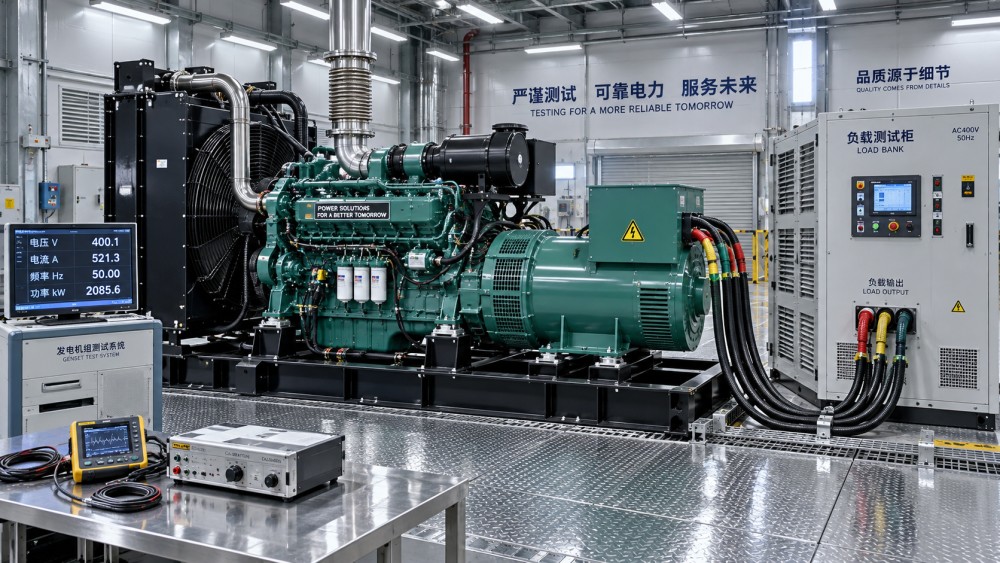
For a routine factory test, request records that identify the engine and alternator serial numbers; controller version where relevant; fuel used; ambient conditions; voltage and frequency settings; test load type; measured kW, kVA, current, power factor, voltage, frequency, oil pressure, coolant temperature, and battery charging condition. The report should record the duration at each test point and any alarms or adjustments made during testing.
Where the application depends on load acceptance, the test plan should include defined step loads and recovery limits. The purchaser may require demonstration of automatic start, rated-load operation, load rejection, protection trips, emergency stop, alarm annunciation, and control-panel interlocks. Requirements should state whether testing is to be witnessed, whether a load bank is acceptable, and whether the final site acceptance test will repeat critical functions after installation.
Separate component documents from package evidence
Engine and alternator data sheets remain important, yet they do not prove that the assembled package has performed as quoted. An alternator certificate may confirm its individual capability; an engine curve may show available mechanical output; neither document confirms wiring integrity, governor response, cooling performance, controller logic, or protection settings in the final set. Procurement should request both component documentation and package-level records.
For alternators, relevant documentation may include insulation-system information, terminal arrangement, excitation system, winding connection, and applicable electrical-machine requirements. IEC 60034-1 covers rating and performance principles for rotating electrical machines. Where the project invokes IEC requirements, the bid should identify the edition and the specific characteristics being applied rather than merely stating “IEC compliant.” Source: IEC 60034-1:2022, Rotating electrical machines — Part 1: Rating and performance.
Turn the specification into a traceable acceptance path
Procurement risk falls when the technical schedule, inspection plan, and final acceptance criteria use the same language. A rating stated in the purchase order should reappear in the approved submittal, factory test procedure, test report, nameplate, operation manual, and site commissioning documentation. Differences should be resolved before shipment, when corrective action is still practical.
An effective document register usually includes approved general arrangement drawings, single-line diagrams, wiring schematics, load assumptions, rating and derating calculations, fuel-consumption curves, factory test procedures, test records, calibration status for critical test instruments, operation and maintenance manuals, spare-parts lists, and warranty boundaries. The purchaser should also identify which records must be delivered before shipment and which may follow commissioning.
Acceptance is strongest when it is based on the operating duty rather than a catalogue headline. The useful question is not whether the set reached a stated output for a short test interval. It is whether the documented configuration can supply the specified load sequence, at the site conditions, for the intended duty and runtime, with records that permit the result to be checked later.
Related News
- What to verify before choosing a smart switchgear manufacturerOct 10, 2026Compare smart switchgears manufacturers by electrical duty, digital integration, cybersecurity, testing, and lifecycle support to select a reliable long-term partner.
- Industrial Generator Set Procurement: Verifying Ratings and Test RecordsOct 14, 2026Industrial generator set procurement guide: verify ratings, site derating, load performance, fuel runtime, and traceable factory test records before purchase.
- How Can Technical Buyers Assess Supplier Advantages Objectively?Sep 28, 2026How can I assess supplier advantages without relying on marketing claims? Use traceable tests, lifecycle risk checks, delivery evidence, and support metrics.
- Evaluating Steam Turbine Suppliers for Captive Power Plant ProjectsSep 28, 2026Steam turbine supplier evaluation for captive power plants: compare steam balance fit, guarantees, quality controls, delivery risk, and lifecycle support before selecting a partner.
Related News
- 00
0000-00
How SCADA grid automation supports remote feeder fault isolation - 00
0000-00
How much does arc-resistant construction add to switchgear prices? - 00
0000-00
How a decarbonization process framework turns targets into action - 00
0000-00
How variable frequency drives cut energy use in water treatment - 00
0000-00
When should high voltage power line maintenance be brought forward?