
A cable tender should specify the cable’s rated voltage in the form U0/U (Um), together with the system voltage, earthing arrangement, applicable standard, installation duty, and any conditions that may create sustained or transient overvoltage. A nominal system voltage alone is not a complete cable requirement.
For a conventional low-voltage three-phase network, a tender might require 0.6/1 kV cable. For a medium-voltage feeder, it may require 6/10 kV, 12/20 kV, or 18/30 kV cable, depending on the network and the standard used. The correct selection is not simply “choose the next voltage class above the supply voltage.” It depends on the voltage that can appear between a conductor and earth, how long an earth fault can remain on the network, and whether the installation is exposed to switching, lightning, converter, or generator-related stresses.
That distinction matters because voltage rating errors often remain invisible during bid evaluation. A cable may appear acceptable on conductor size, insulation material, and price, yet be unsuitable once the operating regime, fault-clearing time, or earthing method is examined. The resulting problem is rarely limited to replacing cable: it can affect accessories, switchgear interfaces, installation methods, insurance positions, commissioning schedules, and long-term reliability.
Start with the rating notation, not the nominal voltage
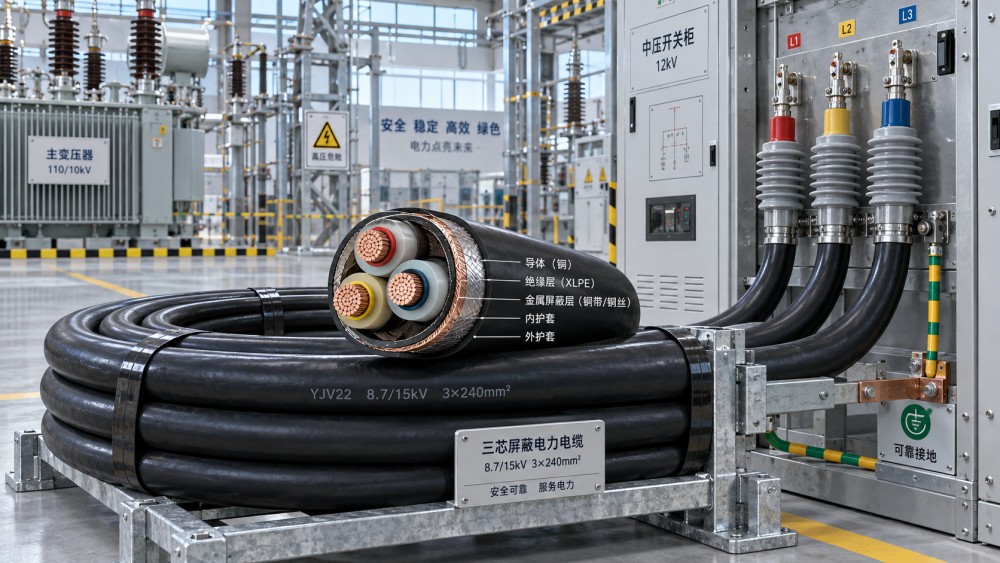
In many IEC-based specifications, cable voltage is expressed as U0/U (Um). These values do different jobs:
- U0 is the rated power-frequency voltage between a conductor and earth or metallic screen.
- U is the rated power-frequency voltage between conductors.
- Um is the maximum system voltage for which the cable is intended.
A tender that asks only for “10 kV cable” leaves room for incompatible interpretations. In one market, the phrase may be used informally for a 6/10 kV cable. In another, it may refer to the network’s nominal voltage rather than the cable’s full rating. Suppliers may quote different constructions while each believes it has met the requirement.
The purchase specification should therefore state the complete designation, for example: “Three-core screened power cable rated 6/10 (12) kV” or “single-core cable rated 12/20 (24) kV,” subject to the governing local standard and system design. The designation should then be aligned with the voltage ratings of joints, terminations, separable connectors, surge arresters, switchgear bushings, and test equipment. A cable system is only as well matched as its lowest-rated component.
The maximum system voltage is particularly important where the nominal voltage is close to the upper edge of a standard cable class. A 20 kV network, for example, should not automatically be matched to a cable chosen only because “20 kV” appears in its designation. The purchaser needs to establish the network’s highest operating voltage and select a recognized cable class that covers it.
Earthing arrangement can change the required cable class
The most consequential tender question is often not the line-to-line voltage. It is how the system behaves when one phase faults to earth.
In a solidly earthed system, protective devices may clear an earth fault quickly. The healthy phases experience a temporary increase in voltage to earth, but the duration is limited by fault clearing. In resistance-earthed, resonant-earthed, impedance-earthed, or isolated-neutral systems, an earth fault can persist for longer. During that period, the two healthy phases can be subjected to elevated conductor-to-earth voltage.
This is why cable standards distinguish between systems with different fault-clearing assumptions. A tender must define whether the selected voltage grade is suitable for the network’s earth-fault operating regime, including the maximum allowable duration of an earth fault. Leaving this to the cable manufacturer without stating the network data transfers a system-engineering decision into a commercial quotation.
For medium-voltage distribution, procurement teams should obtain a clear response from the network designer or owner on the following points before releasing the tender:
- Nominal line-to-line voltage and maximum system voltage.
- Neutral treatment: solidly earthed, resistance-earthed, resonant-earthed, isolated, or another arrangement.
- Maximum duration before a single-line-to-earth fault is isolated.
- Whether the network may continue operating temporarily under an earth-fault condition.
- Whether future network reconfiguration could alter the earthing arrangement or fault-clearing time.
For many projects, this information determines whether the initially considered cable voltage grade is appropriate. It may also affect screen design, metallic sheath sizing, bonding arrangements, and the thermal withstand requirements of the cable’s earth-return path.
Low-voltage tenders should not ignore this issue simply because the nominal voltage is familiar. A 0.6/1 kV cable is commonly appropriate for fixed installations on systems up to 1 kV, but the specification still needs to reflect the actual electrical environment. Circuits supplied by generators, UPS systems, large variable-speed drives, photovoltaic inverters, battery systems, or long feeder runs may require closer examination of insulation duty and protective coordination.
Separate continuous voltage duty from surge and impulse duty
A higher steady-state cable voltage rating does not solve every overvoltage problem. Tenders often become misleading when they treat power-frequency voltage, switching transients, lightning impulses, and converter-generated stress as if they were interchangeable.
Power cables are selected first for their normal and temporary power-frequency voltage duty. That is the purpose of the U0/U (Um) designation. However, installations connected to overhead lines, outdoor substations, long cable routes, capacitor banks, vacuum switching devices, motors, transformers, renewable generation equipment, or power-electronic converters may also experience steep-fronted or repetitive transient events.
For a conventional utility feeder, insulation coordination should establish whether the cable system, terminations, and arresters provide a coordinated response to expected surge conditions. The correct procurement response is usually not to add an arbitrary voltage margin to the cable rating. It is to require the relevant impulse-withstand performance, accessory compatibility, surge-protection arrangement, and applicable test requirements.
Converter-fed motors deserve a separate check. Fast switching edges can create reflected-wave voltage peaks at the motor terminals, particularly where cable lengths are substantial. In this application, ordinary supply-cable voltage class may be only one part of the issue. The tender may need to define inverter-duty cable construction, insulation suitability, screen performance, grounding requirements, and compatibility with the drive manufacturer’s recommended cable length and output-filter arrangement.
Similarly, a solar or battery project may include both AC and DC cable systems. An AC cable designation should not be copied into the DC schedule without reviewing the DC operating voltage, polarity arrangement, insulation requirements, and the applicable product standard. The two systems can share installation corridors while having materially different electrical duties.
Specify the standard and the full cable system boundary
Voltage markings mean little when the governing standard is absent. Tender documents should identify the standard that defines the cable design, testing, voltage classification, conductor construction, insulation, sheath, screening, and routine or type-test obligations. In IEC-oriented projects, common references may include the relevant parts of IEC 60502 for extruded-insulation power cables. Local grid codes, national standards, utility specifications, or project-specific requirements may impose additional conditions.
The point is not to fill the tender with standards citations. It is to prevent bidders from offering cables built to different assumptions. Two products can carry similar-looking voltage labels while differing in tested construction, screen arrangement, fire performance, water-blocking provisions, or accessory system compatibility.
Voltage specification should also cover the equipment that completes the circuit. A procurement package should identify whether the supplier is responsible only for bulk cable or for a complete cable system, including joints, terminations, connectors, link boxes, bonding leads, glands, cleats, and testing. When those packages are split, the interface responsibilities must remain explicit.
A medium-voltage cable, for example, may be correctly rated while its termination is selected for the wrong equipment voltage class, creepage requirement, pollution condition, or indoor/outdoor service. The issue may surface only during installation, when a proposed accessory cannot fit the switchgear bushing or lacks the required interface certification. Tender clarity should prevent that late-stage substitution cycle.
Do not use voltage rating as a substitute for installation design
Over-specifying voltage rating is sometimes presented as conservative engineering. It can be justified where a network is likely to be uprated, where fault conditions are uncertain, or where a standard cable class provides meaningful operational flexibility. But it should be a deliberate decision, not a default response to incomplete data.
A cable with a higher voltage rating can carry a price premium and may bring larger dimensions, higher bending forces, different accessory requirements, or reduced supplier competition. These consequences are especially relevant where cable routes are congested, pulling tensions are limited, or the project requires large quantities of parallel runs. The operational benefit must be weighed against these practical effects.
Conversely, selecting the lowest apparent voltage class can create false economy. Replacement costs are high once civil works are complete, and premature insulation deterioration can be difficult to diagnose. A tender should allow bidders to price the required compliant design, while making any alternative voltage grade a separately identified option with stated technical implications. That approach preserves commercial comparability and avoids burying a design change inside a bid clarification.
Installation conditions still need independent treatment. Ambient temperature, grouping, burial depth, soil thermal resistivity, duct fill, ventilation, route length, armour requirements, mechanical protection, chemical exposure, fire behavior, and short-circuit duty all affect cable suitability. They do not generally change the nominal voltage class, but they can change the cable construction and conductor size required for a reliable installation.
A tender-ready way to state the requirement
A robust cable schedule does not need to be lengthy, but it should eliminate the main sources of interpretation. For each circuit or circuit group, include the system information that lets bidders select and verify the appropriate cable class:
- System nominal voltage, frequency, and maximum system voltage.
- Required cable designation as U0/U (Um), rather than informal voltage shorthand.
- Earthing arrangement and maximum earth-fault clearance time.
- Applicable cable standard and any project, utility, or national requirements.
- AC or DC service, including voltage and conductor configuration for DC circuits.
- Installation method and route conditions.
- Conductor material, conductor size, insulation type, screen or sheath design, armour, and fire-performance requirements where applicable.
- Short-circuit withstand duty for conductor and metallic screen or sheath.
- Required joints, terminations, connectors, and their minimum voltage class.
- Documentation requirements, including test certificates, dimensional data, and declared compliance.
It is also useful to ask the bidder to state any assumptions used in selecting the voltage grade. This is especially valuable when system earthing data is incomplete at tender issue or where the project includes future expansion. An assumption register makes technical deviations visible before contract award, rather than after cable has been manufactured.
Where the electrical design is still evolving, the tender can distinguish between a base requirement and priced alternatives. For example, the base bid can require the confirmed voltage class, while an alternative can cover an uprated class or an enhanced water-blocked construction. Alternatives should remain technically defined and separately priced; otherwise, bid comparisons become unreliable.
The practical decision rule
Specify the lowest standardized cable voltage class that demonstrably covers the maximum system voltage, the conductor-to-earth duty created by the earthing arrangement, and the permitted earth-fault duration. Then address surge exposure, accessories, installation conditions, and future uprating as separate engineering requirements.
That rule avoids two common tender failures. The first is choosing cable from the nominal network voltage alone. The second is adding voltage margin without deciding what risk the margin is intended to address. A clear voltage designation, backed by explicit system data, gives suppliers a common basis for quotation and gives the project team a defensible basis for approval.
Related News
- What Cable Voltage Rating Should Be Specified in a Tender?Sep 24, 2026What cable voltage rating should a tender specify? Learn how U0/U (Um), earthing, fault duration, standards, and surge duty shape a compliant cable requirement.
- What Causes Power Cable Insulation to Fail in Service?Sep 11, 2026What causes power cable insulation failure in service? Discover how heat, moisture, mechanical damage, electrical stress, and poor installation drive outages—and how to prevent them.
- Power Cables for Renewable Projects: Cost Drivers and Spec MistakesJul 10, 2026Power cables for renewable projects: uncover key cost drivers, common spec mistakes, and smarter selection tips to reduce losses, delays, and lifetime project risk.
- Terminal Block Product Information That Actually Matters in Design ReviewJun 30, 2026Electronics product information for terminal blocks should go beyond ratings. Learn what design reviews often miss, from derating and vibration to compliance and wiring reality.
Related News
- 00
0000-00
When market scanning services are worth the investment - 00
0000-00
Which international infrastructure projects are reshaping Southeast Asia? - 00
0000-00
What drives power pricing in long-term supply contracts? - 00
0000-00
What Cable Voltage Rating Should Be Specified in a Tender? - 00
0000-00
Is an IE4 AC Motor Worth the Higher Purchase Price?